Fun Animals Wiki,Videos,Picture,Stories
Showing posts with label spiders. Show all posts

Saturday, December 23, 2017

Animal accidents cost millions


They might be man's best friend but dogs have been involved in 11,741 accidents where people claimed an injury through the Accident Compensation Corporation.
The accidents happened over 12 months, from November 2016 to October this year. In total ACC accepted 55,472 claims related to animals, costing $12.5 million.

According to figures released to the Herald under the Official Information Act, there were also more than 28,000 insect accidents, 5328 injuries caused by cats, 4750 injuries from spiders, 2687 related to horses, 1561 for cattle and 89 accidents involving deer.

Puncture wounds, stings, and lacerations were the most common type of injury caused by an animal, with 35,655 claims.

The next was an occupational disease or infection, with 11,436 claims.

Some of the more serious accidents included 12 people who needed amputation or surgery to remove an eye, four people who suffered deafness, 112 people who sustained a concussion or head injury, and five people who had a nervous shock or mental injury.

Other types of accidents claimed for incidents involving animals included burns or scalds, 5; fractures and dislocation, 839; dental injuries, 608; inhalation and ingestion accidents, 983 and soft tissue injuries, 32.

Children had the highest number of accidents with 8320 claims for zero to 4-year-olds, followed by 5-9-year-olds with 6679 injuries.

More than 750 people aged 85-plus also suffered accidents involving animals, and overall 30,963 claimants were female and 24,509 male.

The total cost of treatment was $7.49m broken down by:

• Medical $6.7m;
• Hospital $571,106;
• Dental $220,193.

ACC chief customer officer Mike Tully said dog-related injuries often happened while the canine pets were off leash and at the park.

"A number of those accidents happen when dogs are outdoors enjoying the freedom, going for a good run, picking up speed and banging into somebody.

"An injury can occur, particularly around the knee."

Tully warned walkers and dog owners to be wary the animals often don't stop in time.

"Just be careful of dogs running toward you, they can be a bit slow to brake. They just don't move.

"Therefore as the dog owner, trying to be conscious of that, that unless your dog is going to listen to you that you may be better sometimes saying to the person where your dog is running to, please step aside or get out of the way."

Tully said people needed to be aware it did not take a big pooch to cause an accident with serious injury.

"Once they've got speed on and they connect with a human being, big or small they can cause some damage."

His warning around horses, cattle and other big animals was to use common sense.

"If you're a farmer, you're around horses, you're around cattle, you generally know how to handle yourself and the stock.

"If you're new to that... I have seen people think 'Well I can pat the horse so therefore I could climb over and get a photo' etc but if you don't know the animal you're dealing with we'd really ask that you keep your distance and use common sense."

Tully said the number of injuries from animals were not increasing but there was often a fluctuation in dog-related injuries.

He issued a warning for pet owners over the Christmas holidays.

"Kids are excited and when kids are excited dogs can get excited. Just be aware of the odd nip and scratch that could occur and we do see that come through ACC at this time of year."
read more "Animal accidents cost millions"

Tuesday, March 14, 2017

5 Terrifyingly Huge Spiders


These massive spiders can’t be dispatched by a shoe or rolled-up newspaper and are sure to give you nightmares—even if you're not an arachnophobe.

1. Poecilotheria rajaei

This recently announced new species of tarantula, found in Northern Sri Lanka, has a leg span of 8 inches—that's roughly the size of your face! It’s part of an arboreal group called tiger spiders, which are indigenous to India and Sri Lanka. A dead male specimen of P. rajaei—which was distinguished from other tiger spiders by the markings on its legs and abdomen—was first presented to scientists in October 2009 by a local villager; a survey of the area revealed enough females and juveniles that scientists are confident they've found a new species. “They are quite rare,” Ranil Nanayakkara, co-founder of Sri Lanka’s Biodiversity Education and Research, told Wired. “They prefer well-established old trees, but due to deforestation the number have dwindled and due to lack of suitable habitat they enter old buildings.” P. rajaei was named after a police officer who helped scientists navigate the area where it was found.

2. Theraphosa blondi


Though Theraphosa blondi is called the Goliath Bird-eating spider, it doesn’t actually eat birds. Reportedly, it got its name when an explorer saw it eating a hummingbird, but like other tarantulas, its diet consists mainly of insects, frogs, and rodents. But we’ll forgive you if you’re not comforted by that fact. After all, this spider can have a leg span nearly a foot across—the size of a dinner plate—and weigh up to 6 ounces, making it the largest spider in the world by mass. Its fangs, up to an inch long, can break human skin. (Though venomous, its poison won't bring down a human.) Native to South America, the spider makes noise by rubbing the bristles on its legs together; the sound can be heard up to 15 feet away.

3. Heteropoda maxima

Yet another reason to avoid dark caverns: Discovered in a cave Laos in 2011, the Giant Huntsman spider has a leg span of 12 inches. It’s just one of over 1000 species of Huntsman spider. These speedy arachnids can chase down their prey with ease and have legs that extend forward, like a crab’s.

4. Golden Silk Orb-Weaver

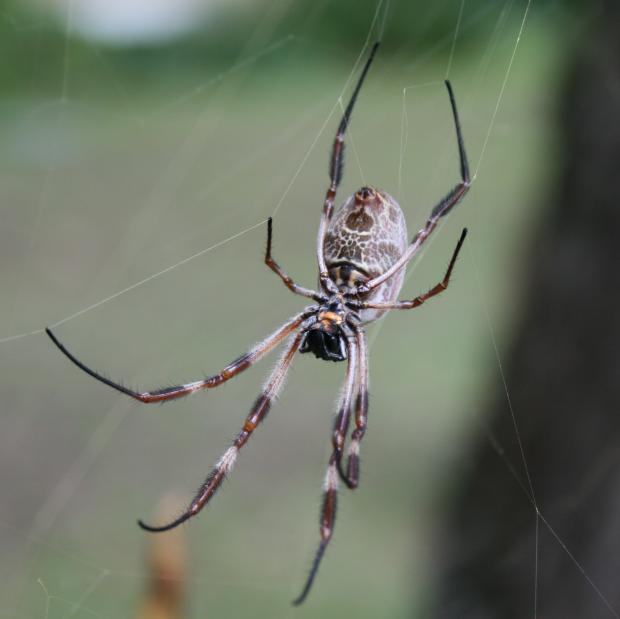
These arachnids, of the genus Nephila, have a fearsome relative: the largest fossilized spider ever found is an ancestor. Females of this family of spiders, which are found around the world, can have leg spans up to 6 inches (the males are smaller). Though these Orb-Weavers typically eat large insects, some individuals in Australia have been snapped eating snakes and birds that got caught in their strong, 5-foot-diameter webs.
 
5. Phoneutria nigriventer

Sure, Phoneutria nigriventer's nearly 6-inch leg span is scary—but there's something else about this spider that makes it even more terrifying: Its venom, a neurotoxin that can be fatal to humans. In fact, along with P. fera, this spider is the most toxic on Earth (thankfully, a good antivenom exists). Native to Central and South America, P. nigriventer is also called the Brazilian Wandering Spider, for its tendency to roam the forest at night, and the banana spider, both because it hides in banana plants during the day and sometimes stows away in shipments of the fruit. When threatened, the spider lifts its front two pairs of legs and sways side to side, like so:
read more "5 Terrifyingly Huge Spiders"

Saturday, January 3, 2015

Spiny Orb Weaver Spider

Spiny Orb Weaver Spider look pretty damn awesome. There are numerous different species of spiny orb weavers, all belonging to the genus Gasteracantha. They’re around 2-9mm in total length and come in a variety of colors and shapes, and some have colored legs too.


read more "Spiny Orb Weaver Spider"

Saturday, August 30, 2014

Top 10 most venomous spiders

Here we take a look at the ten most venomous spiders on earth - taking into account not just the toxicity of the venom but also the amount the spider administers and its aggressiveness as well.


Video

Youtube | Incredible World
read more "Top 10 most venomous spiders"

Sunday, July 27, 2014

Three spiders proven to be not so toxic as what internet circulations claimed


Many information about toxic spiders have gone viral on the internet, published to be so fatal that could cause necrosis. The good thing is, this is written to warn people and to guarantee safety in case real venomous spiders are encountered. The bad thing is, some people who really did encounter these spiders and had been bitten, were so scared to death of what will happen to them after browsing the internet for information.

Australian white-tailed spider

At least it’s good news because one case claimed to have no sign of necrosis after being bitten by an Australian white-tailed spider, a known toxic spider which had a reputation for being so toxic it could kill a human who’s bitten. While the victim was anxious for his own safety, his doctor, Dr. Scott Weinstein, a toxinologist at Women's and Children's Hospital in North Adelaide, Australia has given him treatments and wrote the study after a month of observation in the absence of toxic effects. This new study is now published in the journal Toxicon for updates. 

Hobo spider

 It is also important that people should know so it won't lead to misdiagnosis and other negative effects and complications caused by fear to the victim.

Wolf spider


The three spiders that were wrongly accused are: The white-tailed spider, the hobo spider, and the wolf spider.

Source here.
read more "Three spiders proven to be not so toxic as what internet circulations claimed"

Monday, June 30, 2014

Spiders Cover Roadside with Web


Spiders have always creep people out with their long legs and fangs. But imagine driving down a common looking road only to find millions of spiders taking over the area.

 A whole army of spiders looking for shelter away from the floods in Hikurangi, New Zealand, flied to a portion of the Jordan Valley Road. The area turned white as the spiders spun their webs over the trees and ground. Ben Smith a resident of the Hikurangi Swamp area says that this strange phenomenon happens every year. The Hikurangi area is known to experience flood during the last few weeks of autumn and the spiders would stay near the Jordan Valley Road for about 2-3 weeks. Smith added that when the water rises, the spiders really have no other place to go. They do start dispersing as the water recedes into the swamp areas.
Ross Johnson, biosecurity officer for New Zealand’s Northern RegionalCouncil said that the baby moneyspiders are the main culprits of the spider takeover. During the late autumn and early winter weeks, the spiderlings would each make a long strand of silk. They use these to get drifted off by the winds and get transported to long distances away from the water.

Everything gets covered in silk when the spiders start moving up to higher ground. The spiders could cover trees, gates, even tractors with a thin blanket of their silk. These spiders are also capable of making different kinds of silk. The ballooning silk they produce is different compared to the ones they normally make to build their webs.
read more "Spiders Cover Roadside with Web"

Tuesday, June 24, 2014

Giant Spider Trapped in Car’s Headlights


Spiders are probably the most feared insects around. Recently, a photo of a giant spider went viral when a Reddit user posted a scary photo of a giant spider trapped inside his car’s headlights. The horrified Reddituser jokingly commented that he was going to set fire to his car but other scared him by saying that it could have been an exoskeleton since spiders molt and it could be somewhere inside his car.
There’s no news on what happened to the trapped spider or what kind of spider it was. However, it could have been a huntsman spider. These giant Sparassidae are usually seen in Australia however there are species found in other places such as India, Japan, the Philippines, China and tropical areas of the United States like Hawaii and Florida and areas near it such as Puerto Rico. They’re also called wood spiders, cane spiders and lizard-eating spiders, these spiders can basically thrive anywhere as long as it’s not too cold during winter and there are areas where there’s a lot of trees or wood that they can live in.

Adult huntsman spiders, although able to spin webs, don’t build them. Instead, what they do to survive is forage and hunt for food, hence their name. They mostly feed on insects, but their diet isn’t restricted to them. They occasionally eat small lizards and even birds. They commonly live in tree barks where they spend most of their time hunting, but there are times that they wander off to homes and even cars, which is properly why one got stuck in the headlights.

read more "Giant Spider Trapped in Car’s Headlights"

Sunday, June 8, 2014

Spider Disguises Itself as Bird Droppings

It’s the ultimate crappy disguise: The spider Cyclosa ginnaga hides from predators by looking like a pile of bird feces, a new study says.

Study leader I.-Min Tso, an entomologist at National Chung Hsing University in Taiwan, first made the discovery walking through a research station in central Taiwan.
Spider Disguises Itself as Bird Droppings
Tso noticed Jackson Pollack-style splotches of white bird dung, which stood out in stark contrast to the lush green foliage. But when he looked more closely, Tso realized that not all of the blobs were bird droppings: A few were spiders in their webs. (Read about a spider that weaves a mysterious picket fence.)

Tso recognized the spiders as C. ginnaga, a species found in Taiwan, China, Japan, and South Korea.

As the “architects of the spider world,” spiders in the genus Cyclosa are known to create elaborate webs, using their silk to make concentric circles like Saturn’s rings and adding debris such as twigs and leaves that hide young spiders from predators. (Related: “New Spider Weaves Spider-Shaped Web.”)

Now, Tso and colleagues have discovered their defense strategy is even more sophisticated than thought.

Cornell University arachnologist Linda Rayor applauded the study, pointing out that C. ginnaga is not alone in masquerading as bird droppings.

“It’s really not all that uncommon. Several other spiders, like Bolas spiders, also use this disguise,” she said.

Web of Disguises

To find out if the bird dropping-like web confused predators, Tso and colleagues measured the webs that resembled bird feces.

Source: Here
read more "Spider Disguises Itself as Bird Droppings"

Wednesday, October 30, 2013

Spiders exchange gifts for sex

Female spiders like being courted with gifts from their male counterparts. New research shows that the females store more sperm from males if they bring a gift prior to mating.
spiders
It is not only human males who benefit from flattering that special lady with gifts.

In the world of nursery spiders it is normal for males to initiate mating by giving the female a gift – an insect prey wrapped in silk.
Now a new study shows that this courting behaviour actually pays off for the male nursery spider:

Source: Here
read more "Spiders exchange gifts for sex"

Tuesday, July 9, 2013

Spider webs more effective at snaring electrically charged insects

The positive charge on an insect such as a bee or fly attracts the web, which is normally negatively or neutrally charged, increasing the chances that an insect flying by will contact and stick to the web, said UC Berkeley post-doctoral fellow Victor Manuel Ortega-Jimenez.
spider webs

He also suspects that light, flexible spider silk, the kind used for making the spirals built on top of the stiffer silk that forms the spokes of a web, may have developed because it more easily deforms in the wind and the presence of electrostatic charges to aid prey capture.

Source: Here
read more "Spider webs more effective at snaring electrically charged insects"

Friday, December 7, 2012

The Barn Spider


The Barn Spider is one of the most common types of spiders encountered by many, defined by its yellow and black-striped or streaked body.

Nocturnal, they usually build their symmetrically designed webs in dark areas, thus the origin of its name since they’re often found building their webs inside the cool interiors of barns located in the Northern areas of the United States and in Canada.
Barn Spider
Charlotte’s Web, a children’s novel released in 1952 and authored by EB White, with illustrations by Garth Williams, is hailed for popularizing the barn spider in mainstream media, telling the story of Charlotte, a barn spider, and how she had helped her friend pig, Wilbur.

The story proved to be quite popular as children’s story focusing on the value of friendship, so popular that is had inspired the release of a feature live-action film in 2006.

Though Charlotte’s Web defined Charlotte as a barn spider with friendly inclinations, the thing about real barn spiders is that they’re not exactly the most friendly creatures, known for keeping some distance from other barn spiders in the vicinity.

However, this doesn’t mean that they are likely to attack other spiders or attack anything or anyone that bothers them, as their natural nocturnal inclinations pegs them (somewhat) as loners, creatures who are at their best when left alone.

When talking about keeping them as pets, different exotic pet circles don’t particularly find them all that “interesting”, in the sense that they thrive best outside dedicated enclosures which are typically used in keeping pet spiders, plus the fact that they aren’t as active and exciting to view compared to other known exotic spider pet types.
Barn Spider

Barn Spider

Barn Spider
read more "The Barn Spider"

Friday, July 13, 2012

Barn Spiders


Many people have grown up reading about Wilbur the pig and how Charlotte, a friendly barn spider, saves him from the slaughterhouse. Charlotte’s Web is written by one of the most critically acclaimed children’s story writers of all time, E.B.White, the same writer behind another classic, Stuart Little.
Pig and Barn Spider
In the novel, Charlotte saves Wilbur by spinning a web that says something wonderful about Wilbur. Wilbur becomes famous and even wins a prize at the county fair. The book was eventually adapted into a movie in 2006 staring Dakota Fanning and Julia Roberts, who voices Charlotte the spider.

Barn spiders are brown and yellow spiders that have striped legs. They also have a marking found on the underside of their large abdomens which is usually two small white marks inside a black circle. However, the colors of their markings could vary from one spider to another. These spiders commonly reach an inch to three quarters of an inch in size, and like most orb-weaving spiders, they do not stay in one web for a long time. They take their webs down and spin a new one every night, recycling what they can from their old web. Barn spiders are nocturnal, so they hide during the day and hunt for food during the night. They usually just say in the center of their webs and wait until insects get trapped in them.

Barn spiders do not really like other barn spiders. If two barn spiders come into close contact, they become violent. They can live in one structure, but with a given distance. These spiders are known to be seen in wooden structures and rafters such as farms, sheds and barns. They are also commonly seen in boat houses near lakes. They prefer to stay in cool and dark areas that likely have a lot of small insects that they can prey on.
Barn Spider

Barn Spider picture

Barn Spider image

Barn Spider picures

 
read more "Barn Spiders"

Wednesday, February 29, 2012

Insects and Arachnids as Pets

When talking about exotic pets, insects and arachnids are among the most often mentioned, with spiders generally at the top of most “most exotic pets” lists.

Often kept in enclosures, insects and spiders are relatively easy to keep as pets, not demanding when it comes to space, generally not all that picky when it comes to food, as well as not necessarily needy when regular baths or frequent clean up is being talked about.

Insects and spiders also don’t require that much interaction or attention from owners, unlike cats or dogs. In fact, they’re known to generally fair better without any socialization at all.

But pet insects and spiders also have their own list of particulars, a roster which pet lovers have to think long and hard about before going on an impulse and bringing them home.

Here are some exotic pet facts worth knowing about, before getting your first pet insect or arachnid.

Finding the Right One

For those looking in to keep insects or spiders as pets, specialty pet shops often suggest a “start small” approach, recommending insect or spider species which are less dangerous and/or not so temperamental to keep.

Ant farms are often suggested, especially for kids, given how easy they are to maintain. An escaped colony, though, is a home safety risk, which means that owners have to make sure ants don’t break out from enclosures.

Stick and/or leaf insects are also often recommended, though these require degrees of delicacy with their care. The hissing cockroach is also popular as an “entry level” exotic pet, given that they are pretty docile and large enough for an owner to handle.

Certain types of tarantulas are also often suggested, like the Costa Rican Zebra, the Mexican Redleg and the Chilean rose. These arachnids are venomous, but their venom-factor is somewhat similar to the venom of bees.

If one is not all that keen in keeping a venomous pet, it’d be best not to do so.

Background Information Before Getting One

It pays to do some fact checking before settling on a particular pet insect or spider.

For one, verify with your local agencies’ regulations regarding the legality of owning a particular insect or spider.

Also, gain specifics and particulars related to the care and keeping of insects or spiders, particularly with their feeding. Some tarantulas, for example, require feeding procedures akin to their natural environments. These could be tricky to feed. Though hissing cockroaches are generally easy to feed, stick and leaf insects are more picky with what’s in their diets.

Some insight related to the lifespan of a pet would also be necessary. Certain tarantulas, for example, live as long as 20 years, with females living longer than males

Bottom line, though the basics related to the care of insects and spiders are pets are quite easy to fulfill, in no way does this mean that they're not as “high maintenance” as having dogs or cats in the house.

So? Will you still be getting that tarantula just because it's so cool to have?


read more "Insects and Arachnids as Pets"