Fun Animals Wiki,Videos,Picture,Stories
Showing posts with label siberian husky. Show all posts

Saturday, January 27, 2018

Genetic Testing Might Have Just Explained Why Huskies’ Eyes Can Be Blue


In doing so, it helped show why dogs might be a better target for direct-to-consumer genetic testing than humans.
In an era when direct-to-consumer genome sequencing has been marred by ethical concerns,  rightful skepticism, and Nazis’ fixation with using it to trace their ancestry (many have been disappointed by what they found), a new study may help salvage the field by turning to a previously untapped pool of subjects: dogs.

The research is the first of its kind to be conducted in nonhumans. It drew on data from more than 6,000 customer dogs in an effort to identify the genetic mutation responsible for blue eyes, a striking trait that’s relatively common in Siberian huskies but rare among other breeds in which it sometimes appears, like border collies and corgis. This meant sifting through the genomes of the dogs who did have blue eyes versus those who didn’t to see if any mutations were common to the former group and (mostly) absent from the latter. Owners conducted DNA tests from Embark and completed online surveys detailing their dogs’ breed and appearance, which included uploading “profile photos” for their pups; the scientists, from Embark and Cornell University, took care of the rest.

 The data allowed them to identify a novel association: An allele on chromosome 18, carried by just 10 percent of dogs in the data set overall, was present in 100 percent of blue-eyed Siberian huskies and may be responsible for blue eyes in the breed. It seems likely that a duplication upstream of the gene ALX4, involved in mammalian eye development, is responsible—if so, breeders who can check for the variant in their dogs’ DNA will be better able to select for the trait.

Prospective blue-eyed puppies aside, the success of this first study, now in preprint, speaks to the approach’s potential: Being able to crowdsource genotypic and phenotypic information can lead to key discoveries regarding not just eye color but also more complex traits, behaviors, and overall health. Artificial selection in the form of careful breeding has also left dogs particularly well suited to this kind of analysis—from German shepherds to Chihuahuas, there’s a huge diversity of phenotypes on display, but genomewide divergence is pretty moderate except at the alleles underlying those differences, which is what this kind of testing can help identify.

There’s another reason this small study is exciting. Giving up our own data for such studies is something people are understandably wary of, but the stakes are considerably lower for our pets. And direct-to-consumer DNA studies in other animals could yield worthwhile results—for both them and us. A 2005 paper published in Briefings in Functional Genomics described dogs as “an unrivalled model for the study of human disease,” and regions of the canine genome have already been causally linked to more than 70 Mendelian diseases—heritable disorders caused by a single mutation as opposed to a more complex combination of genes—many of which have human analogues. And since there’s less sequence divergence between humans and dogs than humans and mice (and they’ve cohabitated with us since the hunter-gatherer days), their genomes may be able to reveal things that the murine model can’t. A recent study found that mice first colonized human settlements about 15,000 years ago, but our relationship with dogs may go back more than twice as far. Having shared our environment for so long—and seen us through some key transitions in the process—might put dogs in a unique position to tell us about ourselves.

That’s not to say you should take a genetic testing company’s claims about what your dog’s genes mean for his health without a grain (or more than a grain) of salt. Even if a region of the genome is associated with heritable diseases, that doesn’t necessarily mean a dog or its offspring are guaranteed to have it—we just don’t know enough yet to justify the sweeping, context-less claims many kits are notorious for making. If anything, the benefit of individual testing is that it provides the data for the larger-scale studies that can begin to lay the groundwork for meaningful genome analysis. If you want to sequence your dog’s genome, just remember the result will probably be more meaningful to science than to your ability to care for your pet.
read more "Genetic Testing Might Have Just Explained Why Huskies’ Eyes Can Be Blue"

Thursday, February 5, 2015

The Siberian Husky


Despite its name, the siberian husky is mainly bred in North America and the United States, originally a working dog.


The husky has a thick fur coat which enables the dog to be adequately warm in sub-zero temperatures. This means the husky is often used in the mountains of Alaska and Canada mainly for pulling sleds.
read more "The Siberian Husky"

Monday, May 28, 2012

The Siberian Husky


As a breed, Siberian Huskies are not bad tempered—and may even be too good for humans. These dogs look a little bit like wolves but are more handsome. Siberian Huskies have a pleasant nature. A Siberian Husky is alert, fond of fun and adjusts easily to his environment. Their intelligence is proven. Their all-around ability makes huskies a friend, usually matching to humans at all ages in a variety of situations.
Siberian Husky
Appearance

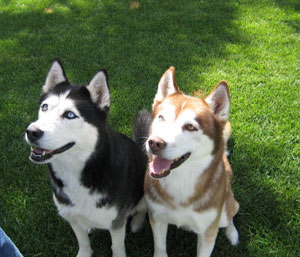
Huskies have a solid body, with erect ears and a tail like a broom. Siberian Huskies have almond shaped eyes lying at an angle—their eyes may be blue (dark or ice blue), brown (from amber to dark brown), or one eye may be blue and the other brown (complete heterochromia) or both eyes partly blue and partly brown. They have a double coat—dense undercoat and longer (but still short) guard hairs. The distinctive nature of their gait is smooth and looks like without power. Siberian Husky male race look masculine but not coarse, females look feminine but without weakness of structure. The color and pattern combinations in the Siberian Husky are similar to the Alaskan Malamute.

Characteristic

The Siberian Husky has a benign nature and is the most benign member of the family of dog ​​sled pullers. Generally, these dogs may also relate to other dogs and other breeds. The Husky is a dog that has high intelligence making them easy to train with love and praise.
In order to keep Siberian Huskies in top shape, they need a lot of exercise and mental activity (their intelligence makes them get bored easily). Because of their thick fur, they don’t do well in hot climates. Their fur also needs weekly grooming, but other than that, requires no other maintenance. They periodically shed their fur in preparation for spring.
Siberian Husky
Feeding

Huskies are known to run under even under a small amount of food. Overfeeding could be a problem in temperate countries if the amount of food is not controlled. It is common to feed them good quality dry food with red meat once a day.

As previously mentioned, Siberian Huskies don’t take well to hot climates so, if you live in the tropics and you get a Siberian Husky, you’ll need to provide the dog with an acceptable environment to make him comfortable. In the tropics, the husky may do well in cool mountain areas.
In Indonesia, for example, a new Siberian Husky can take 2-3 weeks before it adapts to its new home. Rice is mixed into the meat of these dogs’ diet to prevent them from becoming obese and they are fed twice a day, once in the morning and once in the afternoon..
Siberian Husky
Training

Education for Siberian Husky must be given daily. In the morning, exercise for an hour—the type of exercise given depends on the purpose, whether it’s for obedience or dexterity test. The training begins with gentle walking, running and skills, such as teethers, jumping, shaking hands, controlling aggression and so on. The usefulness of this exercise is to hone their skills and intelligence to maintain the health of your pet to stay alive.
Siberian Husky
 Size and proportion

Siberian Huskies are purebred dogs belonging to the Spitz of the north (like the Samoyed). They have average body size, with streaks of light fur and an elegant, powerful and free nature. Their bodies are compact with smooth hair and erect ears. As previously mentioned, they share similar looks with the Alaskan Malamute but their Alaskan cousin is slower and more powerfully built while huskies are smaller and faster.

Height: Males 21 to 23.5 inches at the withers, females 20-22 inches at the withers.
Weight: Males 45-60 pounds (20-27kg), females 35-50 pounds. (16-23kg)
 Siberian Husky Picture
Siberian Husky puppy
Siberian Husky image
Siberian Husky
 Siberian Husky images
Siberian Husky
Siberian Husky Wallpaper
Siberian Husky
Siberian Husky Wallpaper
Siberian Husky
Siberian Husky Wallpaper
Siberian Husky
Siberian Husky Wallpaper
Siberian Husky

read more "The Siberian Husky"