The fun encyclopedia of animals is here! See pictures, wallpapers and videos and read fun reviews of products for animals, how tos, and fun stories about our animal friends here.
Summer hopes for a better life for her and her cat CD. Photo: Paul Jeffers
Summer Jackson and her cat share a common start to life – alone and without a family they wound up living on the streets.
The 20-year-old says CD Princess Cheshire chose her as her owner by meowing at her in an alley off Lygon Street, Carlton.
"Before I found her, I was going to suicide," Ms Jackson said.
"I saved her life, while she saved mine. She needed me and I needed her. I don't know my family, she doesn't know hers."
Perched in front of a glossy high-end retailer's window in
Melbourne's CBD, Ms Jackson has setup for the day, laying out a blanket,
bowl of food and toys for CD, which stands for cat-dog in honour of her
friendly personality.
A cardboard sign neatly explaining their predicament and asking for donations is up front.
Behind a second sign advertising $1 pats and $5 photos, sits CD who, unusually for a cat, does not leave Ms Jackson's side.
Homeless
off and on since she was aged 10, Ms Jackson fusses over her, stopping
to rearrange her blanket or give her a reassuring pat as she speaks.
"When my anxiety and stuff starts playing up, I just pick her up and pat her and that helps me cope," she said.
Ms Jackson is one of a growing number of homeless people who keep pets for companionship and security.
But
with conventional social support services unable to provide pet food, a
demand has grown for services to help provide care for these animals.
Yvonne Hong with homeless man Peter McGann and his dog Bella. Photo: Paul Jeffers
Carrum woman Yvonne Hong saw the gap and about four months ago decided to set up Pets of the Homeless Melbourne, which calls on the public to donate supplies.
Not
all of the few hundred people the group helps are sleeping on the
streets. Some are at risk of homelessness, while others are in temporary
accommodation or are fleeing family violence.
Armed with
plastic zip-lock bags full of dog and cat biscuits, Ms Hong walks the
city's streets on the weekends handing out the pet treats to
those in need.
"I see more and more people with pets on the
street," she said. "A lot of them have no one else in their lives, so
the pet is constantly there with them."
She stops to
meet Peter McGann, 47, who began sleeping on the streets about a year
ago when a workplace accident left him severely injured.
He said a friend bought him English boxer cross, English Staffordshire bull terrier, Bella from the classifieds website Gumtree.
"She helps me with my mental health, my depression, and she protects me at night time," he said.
"I don't have any idiots coming up to me and standing over me."
James Burgess and his dog Yarndi live on the streets in Melbourne's CBD. Photo: Paul Jeffers
Another regular stop is with James Burgess, also 47, who has
been homeless on Melbourne and Sydney's streets on and off since he left
home at age 14 after suffering sexual abuse as an altar boy and regular
beatings.
Life has been traumatic and unstable ever since.
Mr Burgess says Staffordshire bull terrier cross, German shepherd, Yarndie gives him a reason to get up every morning.
"If it wasn't for him, I wouldn't be here," he said.
Kate
Chanter, 34, was first homeless at age 15, but later became a trained
chef before seizures stopped her from being able to work. She's
been back on the streets since July.
She doesn't like to ask people for change, and instead sells The Big Issue and her drawings.
Kate Chanter and her dog Buckley have been homeless since July. Photo: Paul Jeffers
Her moodle cross, shih tzu, Buckley, and the dog's father before it, have helped her get through the dark days.
"We feed them before we feed ourselves," she says. "They're our best mates."
Ms Hong said she is sometimes confronted with people who tell her homeless people shouldn't have pets.
"I
just tell them, you shouldn't judge, because what if you have a home
one day and have all these animals that you love and something happens
to you and all of a sudden you're homeless, what do you do, do you just
give them up?" she said.
"Animals don't really care whether you have a house or not, as long you are there for them."
A video
of animal activists tearing a dog away from a French homeless man, they
accused of using the animal to make money, went viral last month,
prompting outrage at their conduct.
Ms Jackson said this had happened to her too.
"Some people think because I'm homeless, I don't deserve to have a cat," she said.
"So they take her and take her to the pound. I don't use my animal to get money."
Regardless, Ms Jackson lamented that when her cat is not with her, the same people who help her each day ignore her.
Summer Jackson is homeless and living rough with her cat C.D. Princess Cheshire Photo: Paul Jeffers
Nearby a man in poor physical condition, wearing tattered and
stained clothes, staggers around with his hands cupped asking for money.
No one makes eye contact as the stream of people pass him to visit Ms
Jackson.
Noel Murray, from the Council to Homeless Persons, said
it was "outrageous" for people to suggest homeless people's motivation
to get an animal was for financial gain.
In fact, he said many services weren't able to take in a person with a pet.
"They would rather live on the streets than part with their loved one," he said.
Mr Murray said governments needed to adequately fund services to provide for the growing issue.
In England, a former homeless street musician made his way out of poverty after writing a New York Times bestseller about how the relationship with his cat saved his life called A Street Cat Named Bob.
"I think it's pretty cool," Ms Jackson said, familiar with his story.
The orphaned baby sea otter was as sad and
winsome as any cartoon animal Disney ever put on screen. Last October,
the California Department of Fish and Wildlife and the Monterey Bay
Aquarium rescued a tiny pup that appeared to be abandoned by her mother
on a beach near Santa Cruz. Stranded and crying, she was thought to be
less than a week old and weighed just over 2 pounds, the smallest baby
otter found in years.
Luna Lovegood, after all, is a heroine
at the Hogwarts school of wizardry. Like magic, the name won.
Luna appeared on lots of news outlet lists of the cutest animals of
2014. But it’s not just about cute. “Luna has captured the attention of
millions of people and highlighted the plight of sea otters,” says Tim
Binder, who oversees animal care and the rescue rehab program at Shedd.
“She’s become a great ambassador for research and been a great
ambassador for the conservation work not just for Shedd but for all zoos
and aquariums.”
Luna was a rare occasion when public opinion seemed to turn, if just
slightly, toward supporting a belief that many in the animal
conservation world hold: that captivity, when done right, is a valuable
conservation tool.
It’s a hot button issue, to be sure. SeaWorld is perhaps the biggest
red target for those who say animal captivity is inherently wrong. The
criticism of SeaWorld’s theme parks—from the influential 2013
documentary Blackfish to Harry Styles of the British boy band
One Direction shouting “Does anybody like dolphins?” and then “Don’t go
to SeaWorld” onstage in San Diego on July 9—has set in motion plenty of
public outcry. For the past few years, attendance and revenue have
generally declined, although earlier in 2015 there were signs of a potential bounce-back.
But it’s also caused waves of consternation in nonprofit aquariums
and zoos. “The film is not fully accurate, and it portrays events that
happened 30 years ago as contemporary,” says Binder. “The unfortunate
thing is that people are taking that film at face value.”
Their concern is that aquariumgoers now feel conflicted and confused
when they see sea mammals in captivity and with animal trainers, after
seeing and hearing emotion-evoking claims about poor treatment of
“captive” animals. But many of the animals and fish in facilities
accredited by the Association of Zoos and Aquariums (AZA) are rehab and
rescue animals, some deemed “non-releasable” by wildlife officials.
“Almost all black bears, brown—grizzly and Kodiak—bears, puma,
bobcat, harbor seals, walrus, sea otters and moose are rehab animals,”
says AZA executive Rob Vernon. With a few zoo and aquarium-born
exceptions, most sea lions and gray seals in accredited AZA facilities
are non-releasable, rehabilitated animals. Fish like sturgeon or pupfish
in AZA tanks are part of zoo and aquarium-based breeding and release
programs for the federal or state endangered species recovery program.
The majority of public zoos and aquariums consider conservation and
research to be their key missions. For example, last year the New
England Aquarium rehabilitated and released 733 sea turtles (of both
threatened and endangered species) stranded on the beaches of Cape Cod.
It was part of an annual event that typically releases 90 of the
creatures (2014 was a banner year). The New England Aquarium has also
been studying the North Atlantic right whale in the wild for the past 40
years and is involved in changing government policy to decrease
human-caused mortality by entanglement, marine gear and vessel
collision. On top of that, the aquarium has designed fishing gear that’s
less likely to snare whales.
Last summer, the Vancouver Aquarium rescued a marooned false killer
whale (not directly related to the killer whale) calf that it named
Chester. The aquarium has been rehabbing Chester, who was deemed
non-releasable by the Fisheries and Oceans Canada. In a YouTube-worthy
tale of animal friendship, Chester is now rooming with Helen, a rescued
Pacific white-sided dolphin. Vancouver animal care staff say the
integration has exceeded their expectations. “I am extremely impressed
by his medical behaviors already,” reports head veterinarian Dr. Martin
Haulena.
SeaWorld is an interesting case study. The organization has a
documented history of poor environmental stewardship—killer whales and
their pods were disrupted by the repeated SeaWorld captures of the same
Puget Sound pods in the 1960s and 1970s—but also a pretty good track
record of conservation. SeaWorld says it has not taken any whales or
dolphins from the wild in the past 35 years.
Over the past 50 years, SeaWorld has rescued more than 26,000
ocean animals. SeaWorld scientists have published some 300 research
papers that have been shared with the scientific community, including
ones on killer whales’ metabolism, reproduction and vocal learning.
SeaWorld is an institution accredited by the AZA. The SeaWorld park in
San Diego was first accredited by the AZA in 1981, and each of its other
parks has continually met AZA standards in a vetting process that takes
place every five years.
Critics contend that for a long time, SeaWorld didn’t take
conservation seriously enough. “While SeaWorld has done good work over
the years with marine mammal rescues off Florida and California, its
record with regard to research and conservation work that helps wild
orca populations is not very impressive,” says Tim Zimmerman, the
associate producer of Blackfish and writer of the Outside feature “Killer in the Pool” on which the documentary was based.
“Prior to Blackfish, as best we could calculate, SeaWorld
spent considerably less than 1 percent of its annual revenues on
conservation work,” Zimmerman says. “And very little, if any, of that
was devoted to helping the endangered southern resident killer whales,
which are a threatened population in part because of the generation of
young female breeders that SeaWorld and other marine parks removed from
the population in the 1960s and 1970s.”
Similarly, he argues, most of the research SeaWorld conducted on
killer whales didn’t benefit wild populations. Rather, it was directed
toward captive husbandry and breeding that “could help SeaWorld better
care for and expand its captive killer whale population. In short, Blackfish
helped push SeaWorld to start matching its actions on conservation and
research with its long-standing claims regarding conservation and
research.”
After Blackfish was released, SeaWorld promised to donate
$10 million to fund research and conservation for killer whales in the
wild. (SeaWorld says that the announcement was unrelated to the film.)
Recently, it committed $1.5 million to the National Fish and Wildlife
Foundation as part of that pledge. And earlier this month the company
announced it will no longer accept any of the 18 captured Russian beluga
whales it had planned on housing as part of a breeding loan from the
Georgia Aquarium, which, in turn, has been trying to import them from
their home at Russia’s Utrish Marine Mammal Research Station. A
statement from SeaWorld says the decision not to accept the animals
“reflects an evolution in SeaWorld’s position since this project began
more than eight years ago.” SeaWorld
gives universities and research organizations access to its animals.
Scientists conduct studies on subjects such as killer whales’
metabolism, vocal learning, sleep patterns, life history, reproduction
and the impact of toxins and viruses on wild whales.SeaWorld
Many of SeaWorld’s online critics see this about-face as a vindication of recent protests. Blackfish
director Gabriela Cowperthwaite says that since the film’s release,
SeaWorld has been in “damage control mode.” However, she adds, “although
we consider that progress, we continue to wonder why SeaWorld needs
performing orcas to continue conservation work.”
Meanwhile, the Blackfish backlash has affected not only how
people view animals in captivity at both for-profit water parks and
conservation centers like SeaWorld but also nonprofit zoos and
aquariums, particularly when these latter programs are designed to
entertain animals as well as humans. Consider Shedd, which was targeted
in a Blackfish-inspired “Empty the Tanks”
protest in 2013, during which activists called for the release of
captive whales and dolphins. Shedd’s long history of marine wildlife
rescue and rehab programs includes extensive studies of its beluga
whales; aquarists there say that their training program is essential for
the beluga's welfare. Though some people might view the training
process of the whales as abuse for human entertainment, the aquarists
say this is a misunderstanding.
“Sometimes someone might say, ‘Aww, you made him do something he
didn’t want to do,’” says Ramirez, who has been training animals for 30
years. “But if you see someone throw a tennis ball and a dog chases it,
you wouldn’t say, ‘The dog didn’t want to do that.’ That’s dog
behavior.”
He adds, “A lot of people aren’t aware that in modern training at
zoos and aquariums today there is no punishment. Most training is done
through gaining the cooperation of the animal and building that
relationship through positive reinforcement.”
In the larger scheme of things, keeping wildlife in captivity poses
little threat to the survival of the species. The Dolphin Research
Center and the World Wildlife Foundation have stated that the main
menaces to whales and dolphins are climate change, whaling, ship
strikes, entanglement in fishing gear, pollutants, toxic contamination
and the oil industry. Aquariums and research institutes do not make
their lists. The main immediate dangers to the mammals are “almost
certainly entanglement or entrapment in fishing gear,” says Randall
Reeves, the chair of the International Union for Conservation of Nature.
Of course, the practice of purposefully capturing sea mammals for
display, study and entertainment raises ethical issues, many of which
are still being heatedly debated. The wild killer whales that were the
subject of Blackfish are still being disrupted by captures in
Russia today and sent to new aquariums in China and Moscow, says Erich
Hoyt of Whale and Dolphin Conservation, in England, and the Far East
Russia Orca Project.
But aquariums that host and study rescued marine mammals might have a
role to play in saving, for example, New Zealand’s Maui dolphin and
West Africa’s Atlantic humpbacked dolphin, which are so endangered that
Reeves warns they could disappear within a decade. As Bindi Irwin, a
SeaWorld “youth ambassador” and daughter of the late Australian
naturalist and TV personality Steve Irwin, asks, “If we didn’t have
animals in captivity, would we be inspired to save them?”
In a world where the lives of animals are nearly always considered to be unimportant and disposable, it is almost miraculous that so many humans out there are beginning to say “no” to that concept, and do whatever they can to provide animals with the care and consideration that they need.
Some of the lessons that animal sanctuaries can teach us include: we are not the only species on this Earth deserving of love and respect; other animals have thoughts, feelings, and desires of their own – which deserve to be acknowledged, even if we cannot fully understand them; and their right to life should supersede any “services” that we believe they should perform for us. The continued presence of these places, where threatened, neglected, or abused animals can live in peace, is vitally important.
However, a significant number of these places are struggling to keep performing their incredible work. With this mind, we decided to profile a selection of awe-inspiring sanctuaries that are sadly hovering on the brink of closure, and provide more detail as to how you can help them.
Sadly, SanWild has been threatened by the prospect of closure on a number of occasions. Last year,
Joubert warned that unless long-term sponsorship could be found, the
“very harsh reality” of closure could be imminent. It has weathered many
storms but is now struggling to cope once again after being hit by one
of the worst droughts it has seen in many years.
On Facebook, the organization said
the current dry spell has been “the worst since the inception of our
trust in 2000. We are desperate to find sufficient funding to ensure we
can provide a little bit of a helping hand for our animals and prevent
them from starving until the first rains arrive around mid-December. We
are doing what we can, but we simply do not have sufficient funding to
provide the animals with what they need. As they are living inside an
area fenced off for their protection they have nowhere else to turn for
food. As one drives through the reserve wild animals run after our
vehicle in order to get a bit of what we can afford to provide. The
situation is dire and we are all suffering emotionally but for the sake
of those that really need us, we need to be strong and need to continue
to knock on all doors to get them the help they need to survive.”
You can help SanWild at this critical time by making a donation through their website.
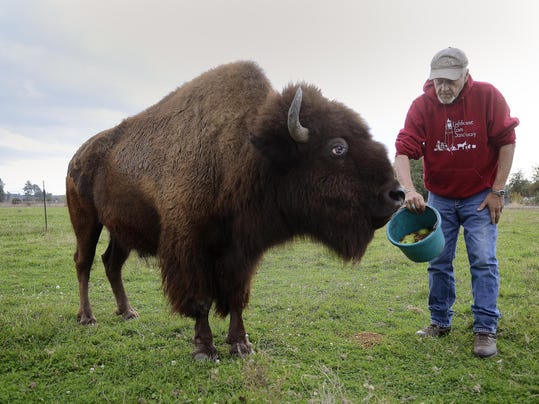
The Lighthouse Farm Sanctuary – named in honor of a local beacon
on Oregon’s Yaquina Head which has “guided those in need to protection
and safe harbor” since 1872 – aims to “guide animals in need to the
safety of calm waters.” Its residents include over 100 cows, goats,
chickens, turkeys, pigs, llamas, rabbits, horses, and geese.
One of their recent rescues, a sweet white-and-brown rabbit named Popeye,
came to Lighthouse with a severe eye injury that required surgical
treatment. During his time with the staff and volunteers of the
sanctuary, Popeye learned how to
“warm up to human affection and even seem(ed) not to mind receiving
meeds while snuggled on a loving lap.” After undergoing surgery to help
fix his eye, and being neutered, he was at last ready to go to “his new forever home!”
The Lighthouse team consider their residents to be friends:
“They light up our day, strengthen our resolve and fill a spiritual
space with love, acceptance, trust and calm. We could learn a lot from
their acceptance of each other – they don’t seem to mind what color
someone’s hair is or the size of their waist or the language they speak.
When it comes to nap time it’s one big snugglefest!”
In July, we reported on this organization’s efforts to tackle a crippling debt problem that has sadly been creeping up on them over time. Paula Fordham, Lighthouse treasurer, said of their financial situation, “I want the public to know that … we’re all committed to the sanctuary’s success. All of us have used our own money to pay for veterinary care for some of these animals.” The dedicated Lighthouse team have set up a YouCaring campaign page to help save the sanctuary, which has attracted $27,151 in donations at the time of writing. Their total fundraising goal is $325,000. You can also donate directly to their website, or apply to work as a volunteer.
Juliana’s Animal Sanctuary,
located in the Andes mountains, is the first farm animal refuge of its
kind in Colombia, and one of only two such sanctuaries in South America.
It is also the ONLY sanctuary in South America that protects cows, in a
continent famed for ”its
rearing of cattle to support the expanding burger industries in the
United States, China and Europe.” It was founded in 2009, “with a desire
to protect one of the most abused animals in the world: cows.”
Future plans include the sponsoring of a mass trap-neuter-return program for the estimated 350,000 street dogs of Bogotà,
along with various education and reconnection programs for
schoolchildren to bring about a change in their perception of farm
animals. Through their new Lunes Sin Carne website, they hope to start running vegan cooking classes and educate the public about the benefits of a plant-based diet.
Juliana’s Farm Sanctuary does not receive any government funding. Unfortunately, the prevalence of poverty and social problems
in the country (up to 50 percent of Colombian people are believed to
live below the poverty line) has limited many animal-loving Colombians’
ability to help the sanctuary. Earlier this year, founder Juliana
Castaneda Turner told
One Green Planet, “I’ve been working alone the last nine years trying
to support my project, and at most I would receive on average about $25
in donations from Colombians. It’s not that people don’t care about
animals, many do, but their focus is on more critical things like
putting food on the table and paying their bills.”
A YouCaring campaign page – called Help Pola the Pig to Save Colombia’s Only Animal Sanctuary, in reference to one of its adorable residents, Pola the Freedom-Fighting Pig – has currently raised $8,067 out of its $25,000 goal. A recent update to the page reminded
all potential donors that “every dollar counts. Even $5 goes a long way
in this country. We are getting closer and closer to our goal.” You can
choose to donate to this trail-blazing organization through the YouCaring page or their website. Alternatively, why not become a member, or even volunteer?
In February, we profiled the amazing Santuario Gaia, a Spanish farm animal sanctuary working to change popular perceptions of farm animals by showing people what unique individuals they really are. Co-founder Coque Fernández explained,
“The peacefulness of the place is ideal for the nonhuman animals who
arrive here, most of them in a terrible state, both physical and
emotional. It helps them to recover faster and provides them with a home
to live in peace and harmony.”
Unfortunately, the sanctuary has lost its original home … but
Fernandéz and the rest of the team are now seeking to start afresh on a
different piece of land. They have stated on their new YouCaring page, Help Us Build the New Santuario Gaia: “Santuario Gaia is a shelter for so-considered farm animals. A place where those have suffered exploitation, abuse and neglect,
receive the necessary life-long care to spend with dignity the rest of
their natural days. Until now, the sanctuary has been situated in Ogassa
(Girona, Spain) on a privileged spot, surrounded by forests, rivers and
mountains, but unfortunately we lost this place and we’ve been through a
very difficult time. However, the sun always comes up after the storm
and today a new era has started for the sanctuary as we are moving to a
new place. Now we, and the animals at the sanctuary, need your support
more than ever.”
As you can tell, the Gaia team are not about to give up on the 260
animals who depend on their care without a fight. To help them with
their goal of rebuild a new home, why not donate through their YouCaring page or their website? You can also apply to be a part-time or full-time volunteer.
There is no doubt about it … attempting to run and finance an animal sanctuary, in a world where most people only value animals as commodities, can be incredibly difficult. As animal lovers, one of the most important things we can do for them is to raise awareness of their plight in any way that we can, and support all those who have the courage to speak out and work tirelessly
on their behalf. Share this article to spread awareness of these
awesome sanctuaries’ work, and be sure to support any other amazing
rescue organizations whose mission is close to your heart! Lead image source: Juliana’s Animal Sanctuary/Facebook
There are many ways to get the world to start saving the wildlife. For instance, not too long ago an enterprising conservationist chose to do his part by getting himself to be swallowed by a giant snake, an anaconda to be exact. A lady with a Ph. D. who is used to working within the confines of her secluded work has set her sights to join the fight and get her hands dirty. And the best way to do it she decided is to take precious time off her laboratory.
The Booming Illegal Industry
It may have managed to stay under the radar but poachers are raking in big when it comes to the number of animals taken from the wilds of Brazil. Recent estimates pega whopping 38 million animals are caught every year satisfying the global demand illegal it maybe. Most of those taken are birds, poised to be caged for pet lovers all over the world, mostly from Rio de Janeiro or Madrid or Sydney or New York.
Credit it to Brazil’s burgeoning demand for exotic pets, its largely weakened laws on wildlife trade compounded with the light penalties meted against violators that the illegal poaching on its wildlife has grown into a $2 billion industry.
Not if Juliana Machado Fereira can’t help it with the simplest of tools: information.
Enter Juliana
Juliana may just be the right person to get the job done. Armed with the right information she is in a good position to raise the fight for wildlife a notch higher.
Based in São Paulo, the wildlife conservationist affirms that it is customary for Brazil and many other South American nations to keep wild songbirds, parrots and macaws as pets. And that this is deeply ingrained right into their very culture.
"Most people have no idea that buying a parrot can have a devastating impact on nature, and support a whole system of illegal activities," she shares. "That's why educating consumers is crucial. Often, just giving them facts changes minds and behavior."
That is the goal of Freeland Brasil,an advocacy Machado Fereira has founded to fight illegal wildlife trafficking. And though she is constantly working with law enforcement at the forefront of what may become a full-blown war against trafficking, her organization wages a different side of the war – raising awareness of the problem via films and lectures and various educational programs for university students and high scholars alike.
Her group informs the public that more often than not, smuggled birds are prone to be mistreated and injured while in transit, with most of them ending up poorly-treated as caged pets. A lot of times, birds are not getting their needs answered, given the wrong food and placed in too small cages.
Yet, Juliana’s aims go beyond these individual animals. She affirms, "I care about the individual birds I rescue. But my real focus is on survival of whole species.”
"Brazil's wildlife is plundered in such huge numbers every day, severe imbalances are occurring within ecosystems," she expounds. "Extinctions of entire local populations can happen, and that affects many other prey and predator species up and down the food chain."
In the bigger picture, the illegal trade in Brazil has long-term side effects, definitely not beneficial for the human race. Altering local ecosystems result into inbreeding problems, weakening seed dispersal and producing inadequate pollination on many farms.
Taking a Stance with the Police
Yet, to a large extent, Juliana has contributed a lot more than just providing the right information to buyers of illegally-acquired wildlife. A large portion of her work is targeted at developing handy scientific techniques that give law enforcement agencies leverage in battling traffickers.
Armed with a Ph.D. in genetics, she was able to come up with species-specific molecular markers enabling police to identify the exact origins of a seized bird, for instance. Also, this acts like a lie detector separating legally bred species with illegally acquired. Additionally, this molecular tracking makes it a lot easier to return rehabilitated birds to the spot where they should be.
The delicacy of the matter is echoed by Machado Ferreria who stipulates, “"Even within the same species, distinct groups with unique genetic differences can evolve as they adapt to particular environments." Further, she added, “So if a scarlet macaw that was stolen from a forest in the northeast is returned to a forest in the northwest, it could mate and jeopardize the long-term health and viability of that local population."
A Most Versatile Wildlife Activist
Machado Ferreira’s work has seen her forging a decade-long research collaboration with the world-renowned U.S. Fish and Wildlife Services National Forensics Laboratory. Over the years, however, she has learned to spend lots of time outside her lab.
Her Freeland Brazil, a global partner of Thailand's Freeland Foundation– another group at the forefront of putting wildlife trafficking and human slavery to an end –gives police needed training to lower the escalating death rate of seized animals. To date, she’s putting key knowledge into a guidebook to help law enforcement agencies in the fight against illegal trafficking.
It’s no wonder Machado Ferreira’s name has become synonymous with wildlife conservation efforts catapulting her to the national scene. And she’s upping the ante. Helped by SOS Fauna,an animal welfare group, she goes with law enforcement in the field, even joining key police raids helping identify and count animals in the process. This work is fraught with danger as it revolves around danger-prone street markets.
"Traffickers don't want to risk bringing all their merchandise to a fair, so police intelligence information [has] also led us to homes near the markets where illegal cargo was held," she explains. "We would stake out surveillance in front of those houses and then join the raid to seize the animals."
She is bringing the fight even to the political arena, lobbying for stronger anti-trafficking laws to Brazilian legislators. However, she knows that the road to redemption is still a long way to go saying: "The lobby which supports the wild pet trade is very strong, powerful, and well-financed."
She envisions a cross-border network much like the more successful ASEAN Wildlife Enforcement Network and acknowledges a great need to be bold now saying, "We need to act now—or we'll have nothing left to protect."

 Summer hopes for a better life for her and her cat CD. Photo: Paul Jeffers

 Kate Chanter and her dog Buckley have been homeless since July. Photo: Paul Jeffers
 Summer Jackson is homeless and living rough with her cat C.D. Princess Cheshire Photo: Paul Jeffers