Fun Animals Wiki,Videos,Picture,Stories
Showing posts with label Naked Mole Rat. Show all posts

Thursday, February 1, 2018

Unlike Other Animals, Naked Mole Rats Don’t Seem to Age


THERE’S PLENTY TO BOGGLE THE mind in the life and biology of the naked mole rat. It’s not much to look at it—this priapic rodent has a wrinkly layer of skin that seems a few sizes too large, dangling incisors that it uses like chopsticks, and four little hand-like paws. But an inauspicious exterior conceals an extraordinary body. The naked mole rat can survive without oxygen for 18 minutes, has a natural protection against cancer, and feels little pain. Now, a new study from Google’s anti-aging company Calico suggests that it doesn’t even seem to age.
Don’t believe the wrinkles.
Most mammals, including humans, are subject to what’s called the Gompertz-Makeham law. Basically, as we get older, things stop working as well as they once did. Between the age of about 30 and 80, hearts get weaker, knees give out, and the human machine starts to feel less well-oiled. It sounds like a truism, but as we get older, we are exponentially more likely to die, with our mortality rate doubling roughly every seven to 10 years after our 30th.

Fascinatingly, naked mole-rats don’t seem to be subject to this natural law. Instead, the risk of mortality remains about one in 10,000 on each day of a rat’s life, way beyond the six-year lifespan scientists say they’d expect of a creature this size. In short, as the researcher Rochelle Buffenstein told Live Science, if you’re a naked mole rat, it doesn’t matter how old you are. “Your death is random,” she said.


The study has raised a few eyebrows elsewhere in the scientific community, with other researchers calling for more data over more years. But Buffenstein said the data seemed conclusive—that they used well over 3,000 animals in their research, none of whom showed signs of aging.

That isn’t to say that they’re immortal, of course. Naked mole rats do die, but they don’t seem to do so because their hearts or bones age like our own. Neither do their reproductive systems stop—females never reach menopause and can carry on having offspring right up until the very end of their lives. And they also don’t get the kind of chronic diseases that go alongside aging: no diabetes or Alzheimer’s. In the wild, they might die from being eaten by a predator or due to infection or a lack of food. In the lab, where the oldest known specimen trundled along for 35 years, death often comes from infected mouth sores, suggesting that the animals weren’t eating, drinking, or producing saliva as they should—but these are as likely to come by when the animal is 10 as when it is 20.
read more "Unlike Other Animals, Naked Mole Rats Don’t Seem to Age"

Saturday, February 14, 2015

7 of the Strangest Looking Animals on Earth


Not all animals end up as extravagant and colorful as peacocks or as cute and cuddly as giant pandas. Some of them look very strange and sometimes even scary. However, even if these animals are a bit of a fright to look at, most of them are actually pretty harmless.
Below are 7 of the strangest looking animals on earth.

California condor
California condor
A very rare bird that’s found in North America, the California condor shows a lot of grace when it glides above the deserts and canyons of North America’s west coast. Up close, however, this giant bird definitely isn’t photogenic. Its head is bald, adapting to its nature as a scavenger. Feathers on the head might become bothersome and clotted with blood as it feeds on carrions.

Blobfish
Blobfish
This fish looks more like a ball of goo with a face. It’s slimy, gelatinous appearance actually helps it survive its natural habitat. Blobfishes live in very deep parts of the world’s oceans, so its pudding-like body helps it endure the high pressure and stay buoyant.

Naked mole rat
Naked mole rat
Life’s very difficult when you can’t see. However this isn’t an issue for naked mole rats. These hairless rodents spend most of their time underground, dinging for insects and worms in colonies. Their furless bodies help them adapt to the underground environment and they have very little need for sight. For an animal its size, they have a pretty long lifespan, reaching about 30 years.

Proboscis monkey
Proboscis monkey
We humans might think that a giant nose is embarrassing, but for these monkeys, the bigger their nose is, the better it helps with looking for a mate. Proboscis monkey live in groups composed of a male and multiple females and their young. Some all-male groups also exist, composing of juvenile males. Their big nose also helps them make loud warning calls.

Warthog
Warthog
A wild member of the pig family, these animals are characterized by their snout, medium sized tusk that protrudes from their mouth, and a curvature that looks like a wart on their face, hence their name. They also have a mane that runs down their backside. Commonly seen in the grasslands and savannas of sub-Saharan Africa, these pigs are well adapted to surviving the harsh heat of their environment.

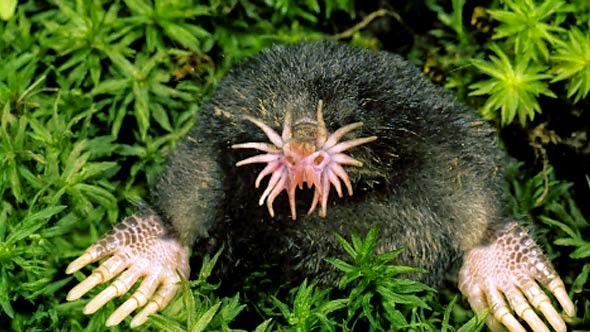
Star-nosed mole
Star-nosed mole
These moles look like any other regular mole, except for their noses. They have a bizarre star shaped nose which they actually use to help them find their way around their habitat. Star-nosed moles have 22 small, fleshy appendages on their snout that function more like sensitive fingers. Their snouts contain 25,000 sensory receptors that the more uses to guide itself though their underground lair.

Aye-aye
Aye-aye
This creature, which looks more like a gremlin, is actually related to monkeys. Not only do they look unusual, they also have strange traits like tapping on tree branches and trunks with their long, bony fingers to looks for grub and insects. Found in Madagascar, many locals say that this animal brings bad luck, but it’s actually just a harmless creature of the night.
read more "7 of the Strangest Looking Animals on Earth"