The fun encyclopedia of animals is here! See pictures, wallpapers and videos and read fun reviews of products for animals, how tos, and fun stories about our animal friends here.
A collection of giant LEGO birds have been unveiled today at WWT Martin Mere.
The 10 characters that form part of a LEGO brick animal trail were made from 123,200 LEGO bricks and took over 965 hours to build.
This is the first time these amazing sculptures, especially created for WWT, have been seen in the North West among the real life animals which inspired them.
A brand new addition to the trail was also unveiled, Kate the Kingfisher, who the CBBC Blue Peter presenter Barney Harwood helped to build.
She has been made especially for the Martin Mere trail and is being
featured on Blue Peter, along with her other giant brick friends who
Barney also helped put out on the trail on CBBC on Thursday, December 3.
Through the giant brick animal trail, the nature reserve in
Burscough, Lancashire is using the world’s most popular toy to encourage
kids to build a better future for nature.
What animals can you see on the trail?
Visitors
to Martin Mere Wetland Centre can enjoy the 10 individually-designed
LEGO brick characters revealed for nine weeks over the winter including
the Christmas holidays from this Saturday, November 28 to Sunday, January 31.
You will be able to see all sorts of animals including:
Kate the Kingfisher
Flavia the Andean flamingo
Benedict the Bewick’s swan
Emily the Emperor dragonfly
Lottie the otter
Bruce the Red Breasted goose
Lottie the Otter
Nick Brooks, Martin Mere’s general manager said: “Here at
Martin Mere Wetland Centre, we take particular pride in helping to
conserve the Hawaiian goose (Nene) the world’s rarest goose, which was
originally identified as a species that needed protecting by our founder
Sir Peter Scott.
“Today, we are using LEGO bricks to inspire the next generation to continue Sir Peter’s work of saving threatened wildlife.”
Mac the Mallard
What else can you do when you visit the trail?
As
well as the trail, budding sculptors can take part in creative fun and
games at exclusive LEGO brick workshops at weekends and daily through
the Christmas holidays, build minifigures and buy limited edition mini
LEGO brick animal models, only available at WWT.
All proceeds will support WWT’s essential conservation work in the UK and around the world.
There
is no extra cost to meet the giant LEGO brick animals at Martin Mere
Wetland Centre, the trail is included in the admission price.
Hannah Clifford from WWT Martin Mere with Kate the Kingfisher
Places for the workshops can be pre-booked online HERE.
To find out more about the Giant LEGO brick animals and other brick activities visit wwt.org.uk/legobrickanimals or follow #LEGOBrickAnimals.
Win a LEGO experience day at WWT Martin Mere
The
prize is free entry to Martin Mere for a family of four, a Lego animal
kit, free Lego workshop for the children (one hour at the centre doing
fun activities plus build your own Lego duckling to take home) plus
lunch at the centre.
Five runners up will win family tickets to visit the centre to see the Lego brick animals. The competition closes at 3pm on Friday, December 4. Winners will be informed by email.
The prize must be redeemed anytime on or before January 31, 2016.
This column is part of a series where Verge staffers post highly
subjective reviews of animals. Up until now, we’ve written about animals
without telling you whether they suck or rule. We are now rectifying
this oversight.
Lizards can sit unnaturally (or super naturally) still, stare, and
then move in a flash — alien movements at alien speeds. Our feeble human
desire to anthropomorphize everything is stymied at almost every turn,
and somehow this makes the creatures all the more compelling.
Then there's the leopard gecko (Eublepharis macularius,
which is basically Latin for "good eyelid, spotted"). The leopard gecko
is a lizard that evolved away the things you expect from a gecko. It has
no sticky lamellae
on its feet for wall climbing, it has blinking eyelids, it tends to be
more docile around humans. The leopard gecko is strange to its brethren,
but in ways that make it more approachable to us. It's become a popular
pet — one that can live for 20 years if you treat it well — because
it's an otherworldly creature that you can keep in your home. One you
think you can know.
But let's get this out of the way: the leopard gecko is still weird as hell.
You've probably heard that geckos have tails to store fat and they
can detach them to run away from predators, then regrow them later. In
fact, you don't need to and actually shouldn't feed an adult leopard
gecko every day — that's why the tail is storing fat. Leopard geckos
also detach their tails; as they do, a specialized muscle clenches up to
prevent blood loss. They lose their energy reserve, but they live to
grow another one later. They're chill, they got this.
But it gets crazier than that: the detached tail can flop around to attract the predator while the gecko makes its getaway. It doesn't just do it once, either, as Wired
notes. No, instead it just goes and goes, an unholy unliving thing
scampering around so that its former host can skitter away to survive
another day. Behold:
Leopard geckos shed and then eat their skin, too, the better to avoid
getting tracked. Their ear canal goes straight through their tiny
little skulls — shine a flashlight and you can basically see right
through. It's thought to have spectacularly good eyesight, able to see
color in the dark.
Most of the leopard geckos you'll encounter are bred in captivity —
and because we can't leave well enough alone, there are morphs with
stripes and stipples and other weird skin characterizations. But they're
originally from a swath of land running from Iraq to Pakistan. That
doesn't necessarily make them desert creatures, but they're optimized
for arid and dry land. One of those optimizations is that they hang on
to as much water as possible. Instead of excreting nitrogenous waste in
liquid urine, they drop little powdery white crystals called urates.
As pets, leopard geckos feed on crickets (usually coated with a
nutritional powder) and astonishingly named pinkies — tiny little baby
mice. Watching any predator hunt is mesmerizing and horrible, and
watching a lizard do it even more so. Don't watch this video:
You watched, didn't you? You saw that right foot hover over the
ground and watched that lizard brain plot. You couldn't look away, all
the way through to the awful and disturbing end.
Here's the thing about the leopard gecko. It seems custom designed as
a "starter reptile" pet, the kind of animal that's easy to care for and
more approachable than a snake. Those tiny little feet with their
harmless claws. Those eyes with actual lids that make you believe that
you understand the expressions it's making. The fact that it won't grow
massive and ornery like an iguana.1
They're not slimy. They'll hang out on your shoulder. They'll blink
those quiet eyes at you like a contented cat and you will feel like you
have made a connection.
Seriously, iguanas live longer and get meaner than most people
realize and thus end up either abused or abandoned into hostile
environments — environments which they often end up damaging themselves.
There are lots of animals with tiny brains that we believe we're forming relationships with (R2D2 budgies 4 life), but with the leopard gecko it's just a trick. It's not a cat-level brain-altering chemical
trick, but you're being fooled nonetheless. These evolutionary traits
aren't there to warm your heart, they're there to make the gecko a more
efficient killer — one who adeptly evades other predators.
Reptiles do not think the same way you or I do — they're mysterious
in ways that go beyond the cliche of "tiny lizard brains." But because
of how it looks, the leopard gecko is the lizard that most makes you
believe that you have bridged the implacable void between the minds of
mammals and reptiles. But sorry, it isn't true. You do not know the
leopard gecko, it does not know you.
Waking at 4AM to soundless dark — where the leopard gecko can see
things you cannot — you might realize that it's not just reptiles you
cannot truly know. Your friends and lovers are also inscrutable, in
their way. Their minds and modes of thought belong to another world —
their own. Are you fooling yourself, when you think you understand their
hearts?
While you wait for the light to strengthen, think of the leopard
gecko; maybe the difference between pretending you know a creature and
actually knowing the creature doesn't matter. You can sate the gecko's
hunger and make it feel safe enough to keep its chubby little tail
attached. It can rest upon your warm palm and close its eyes and make
you feel like you have helped another creature find its way in a harsh,
cold, and uncaring world. Maybe that should be enough. Maybe you don't
need objective proof that there is more than that.
Also, let's be honest, the little lizards are super cute.
The growing field of animal-assisted therapy has helped many anxiety and depression sufferers cope with their symptoms, writes Katie Byrne
She tried prescription medication, psychiatry and therapy, but nothing could tame the black dog that gnawed at her very essence.
As she descended into a state of hopelessness, she decided to do "one
hopeful thing". She bought a Golden Retriever puppy called Bunker.
Little did she know how much solace he would provide...
"Bunker
didn't ask me to tell him how I was feeling," she recalls. "He didn't
need me to label my emotions, to tell him what had happened or why I was
so sad. He just met me where I was.
"He met me physically, on the floor, and pressed his body into mine,
licked my face, made me take deeper breaths than I had in days, made me
laugh even. He had no expectations. He didn't care if I felt better. He
just wanted me."
There is a quote often found on the waiting room
walls of veterinary surgeons that reads: "There is no psychiatrist in
the world like a puppy licking your face". It's a sentiment that
resonates with Barton. She calls Bunker her "lifeline".
Ciara Morrison with her turtle Stomp
"That unconditional acceptance is so very freeing for someone
suffering from a dire sadness," she continues. "And it's something a
human can very rarely do for another human. Only an animal can
consistently do this for us."
Barton's relationship with Bunker is the subject of a memoir, Dog Medicine, which was released last week.
Dublin-born healthcare assistant Ciara Morrison is one of the many people looking forward to reading it.
Morrison
can relate to the story. She suffers from acute anxiety and has been
attending psychiatric services since the beginning of 2012.
"Throughout the first year of being in and out of hospital, I had a
little dog called Teeny and I absolutely adored her," she explains.
"She
used to know when something was wrong. If she ever heard me crying, she
would come running like some sort of mini superhero! When she'd reach
me, she'd lick the tears off my face until I laughed and then dutifully
curl up in my lap and stay there until I'd move her.
"If I was very depressed and struggling to get out of bed, she'd be there licking my face and nudging me until I moved."
These
women's stories aren't unusual. Dogs are well known to promote healing.
Studies show that just a few minutes of bonding with a canine can lower
blood pressure, slow the heart rate and reduce shallow breathing.
Julie Barton, author of the much-anticipated memoir, Dog Medicine, and her dog Bunker.
However, while the therapeutic effects of dogs are the most studied
and documented, there are many more animals proven to provide comfort
and support.
Vlogger Melanie Murphy, who was diagnosed with
generalised anxiety disorder at 19, believes that cats can help reduce
stress and ease tension. And she should know - she once owned five
feline friends.
"When you're stressed, hug an animal. That is the best advice I can give to the world," Melanie (pictured below) says.
Emerging
research suggests that a cat's purr, like other low-frequency
vocalisations in mammals, may have healing properties. It's better known
as "purr therapy".
Equine-assisted therapy is another growing field. Therapeutic riding coach Sandra Schmid of Hairy Henry Therapeutic Riding (hairyhenry.com) in West Cork has many success stories.
"There's one young girl who started with me when she was eight.
She'll be 11 soon. When she first came to me, she struggled with
separation anxiety and panic attacks.
"She has grown hugely in
confidence over the years. She still suffers from panic attacks at
school and at home, but she has never had one when with me, despite two
falls off the horse and a couple of other minor incidents."
While
equine-assisted therapy can be an investment, there are many more forms
of animal-assisted therapy for those that can't afford it.
Even the passive act of watching fish swim has been proven to reduce
anxiety, while smaller, less time-consuming animals can be just as
therapeutic.
Morrison has since bought two tortoises called Stomp
and Brutus. "I find it so relaxing to tend to their table. It's like my
own mini, indoor garden," she explains. "I spend ages arranging it and
placing nice stones around, building little mounds for them to climb.
It's a great way to stay present in the moment and practice mindfulness
with very little effort."
She adds that those suffering with mental health issues should be mindful of the upkeep required with certain pets.
"Don't take on a complex animal that requires stringent care if you
are still in an early phase of your recovery," she says. "Taking on too
much could actually stress you out more. Start small."
It's a
point echoed by Barton. "I caution against a severely depressed person
rushing out and getting a dog, especially if they've never had a dog or
didn't grow up with them.
"When I adopted Bunker, I was in a
particularly rare and privileged position of having no job, no kids, two
capable caretakers in my parents and no immediate financial concerns."
She also reminds that animal therapy can come from all manner of
sources. "There's all kinds of medicine out there in the animal kingdom.
It's merely our job to be vulnerable and open enough to see it and
accept it."
It’s been a weird year for skateboards. As foretold, hoverboards are here, but they’re either really limited in what they can do or they’re not actually hovering. Fortunately, Peru’s Otto the Skateboarding Bulldog is here to set us straight: What matters isn’t how the board moves, it’s how cool it looks when a dog is the one riding it.
Yesterday, Otto skateboarded through a human tunnel 30 people long, setting the “longest human tunnel travelled through by a skateboarding dog” record, a very important feat. The event was part of Guinness World Record Day 2015, when a bunch of people (and animals, I guess) do weird unique things more so than other people (or animals) have ever done them before. We live in a strange and beautiful world that encourages and praises this behavior.
The best entries in the inaugural Comedy Wildlife Photography Awards have been named
This year's winning photograph, by Julian RadPhoto: Julian Rad
The above image of a wild hamster, cheeks filled with food, expression
of quiet determination writ large across its furry brow, has been named
the funniest animal photo of the year at the inaugural Comedy Wildlife
Photography Awards.
The hamster, or rather Julian Rad, the Austrian who captured it, beat
hundreds of rivals to the top prize, earning himself a one-week holiday
in Tanzania and a Nikon D750 camera in the process.
This stag took second place Photo: William Richardson
Second and third place went to a pair of Britons: William Richardson,
for his photo of an impeccably camouflaged stag in Richmond Park, and
Oliver Dreike, for an image of a gorilla that swears it was just
scratching its nose. Honest.
This gorilla swiped third Photo: Oliver Dreike
Given that the award is in its first year, the number of entries - more
than 1,500 - was impressive, as has been its global reach, with those
entries coming from as far afield as Iraq, Macedonia, Uruguay, Belize
and Sri Lanka.
This distressed hippo was one of 10 "highly commended" entries Photo: Marc Mol
Images of animals looking foolish clearly hold a special place in everyone’s heart - regardless of nationality.
So too was this graceful cheetah Photo: Mohammed Alnaser
Among the judges were Hugh Dennis, the actor and comedian best known
for his role in BBC’s Outnumbered, and Kate Humble, the broadcaster and
regular contributer to Telegraph Travel, as well as several respected
wildlife photographers, such as Will Burrard Lucas and Tom Sullam.
This ninja squirrel Photo: Julian Rad
“It was a pleasure to judge the inaugural Comedy Wildlife Awards,” said Hugh Dennis.
This amused seal Photo: Julie Hunt
He added: “The number and quality of the entries was fantastic. The
finalists should be very proud of themselves, as should the animals they
photographed, simply for looking so funny. Sadly there is no way of
telling them.”
This flapping bird Photo: Charlie Davidson
In addition to being extremely entertaining, the awards aim to raise
awareness of the work of The Born Free Foundation, the conservation and
animal rights charity.
If Sony's PlayStation 4 lineup is anything to go by, 2016 will be the year games go to infinity. The headline grabber is No Man's Sky, of course, but for those not keen on space travel, there's another option that's also crazily ambitious. Wild
is many things—an adventure game, a survival game, a riding on the back
of a bear and skidding his bum along the side of a mountain game—and,
like No Man's Sky, it's a game of infinite exploration.
The idea, at least for now, is that players—taking on the role of a
shaman—must simply survive. As day turns to night, the world of Wild
becomes nasty, and those without shelter or means of protection will
succumb to the animals that roam at night. How exactly players will
build that protection is something of a mystery for now, although I'm
told that climbings up trees is a good place to start. Indeed, much of
how Wild will work still seems to be completely up in the air.
Every explanation for how the game works is prefaced with the phrase "In
the current build..."
But that's not to detract from what is one of the most interesting
and exciting games to have come along in years. Survival games aren't
all that rare these days—particularly for PC gamers—but one with the
scope of Wild is. It's a solo experience, but it's also a
multiplayer experience. The animals that roam the world might be AI
characters, or they might other players who've channelled their own
shaman's spirit into the body of an animal to either help or hinder you
on your journey.
You can do the same, of course. As shown in the Paris Games Week
stage demo, the shaman can meditate, and take over an eagle's body to
swoop down from the sky and capture a snake. Or the shaman can summon a
bear, clambering onto its back to traverse the world—complete with an
amusing bum-sliding animation—or use its strength to fight enemies.
There are no swords or weapons (again, at least in the current build) or
anything other than animals that can help you survive.
While Wild will never tell you to go anywhere, or do a
particular thing (there isn't even a HUD), its survival systems are
geared towards pushing you to interact with animals, and making them
your allies. At the start of the game, this is easier said than done.
With no allies to start with, you're left hunting smaller animals, or
those that are easier to catch, like a frog or a rabbit. And when
caught, they must be brought to an oft-guarded divinity stone, where the
animal god (a snake in the stage demo) will set a task before you can
summon their power.
You may be asked to kill one of your other animal compatriots, or be
forced to live as a particular animal for several days, hunting what it
hunts, and eating what it eats. And if it's a larger animal like a bear,
then it's more complicated than simply capturing it. The bear must be
domesticated first, either by raising one from birth—and that means
feeding it, walking it, and other parental responsibilities—or by
finding an injured bear and nursing it back to health. With each new
animal that the shaman learns to control, a new tattoo is etched across
the shaman's skin.
If this all sounds a little bit out there, don't worry: it is. Like Dreams—which also got a showing in Paris—Wild
defies convention. Perhaps the only thing that's conventional about it
for now, is what happens when you die: if you're an animal, you go back
to the shaman; if you die as a shaman—something that will happen if you
leave him or her out in a vulnerable spot while meditating—you go back
to the last camp or shelter that you made or discovered. That there's no
permadeath in a console game isn't that surprising, mind.
But I suspect the camps will stick around. If nothing else, needing to
discover camps and shelters will encourage exploration, and in a game
where "everything" can be explored, keeping people interested is just as
important as giving them a vast world to explore. And if you're
wondering how a tiny studio like Wild Sheep is making a seemingly
infinite game—even with the backing of the legendary Rayman creator Michel Ancel—look no further than procedural generation, or least something very similar.
"The tech means that the game is actually infinite," explained Ancel,
"but infinity can be very boring. The world is made up of a lot of
different technologies, so you could say that [it's
procedurally generated]. I will say that, as a developer, we are helped
by the technology to create a game world without spending time creating
every single piece of grass, so there is a big system in place helping
to create things. It's a balance between homemade things, and generated
things. But yes, we use a tool to generate the world in real-time."
I wonder whether—after we've all tried to survive yet another night in Wild, or explore our 10,000th planet in No Man's Sky—infinity
will be quite as appealing. Maybe, by the end of 2016, we'll be
clamouring for a good ol' fashioned scripted campaign. Or maybe, just
maybe, Wild will keep us interested. It has the tech, it has
the ideas, and it's just weird enough that it might actually work... "in
the current build" at least.
Wild is under development exclusively for PS4. There's currently no release date.
The downtown salon 360 Hair & Nails is hosting their annual Cause
for Paws Cut-a-thon on Monday, Nov. 9, when Winnipeg Square will be
taken over by hair stylists and estheticians to offer haircuts and
manicures from 7 a.m. until 5 p.m.
The event is held in support of the roughly 8,000 animals that are
taken in each year by the Winnipeg Humane Society. Special guest
appearances by The Winnipeg Police Services’s K-9 Unit and Winnipeg Blue
Bomber mascots are planned from 11:30 a.m. until 1:30 p.m. as part of
the day’s festivities.
All proceeds from the $20 haircuts and $10 manicures (includes polish
and nail art) will benefit the animals the society cares for. In
addition to haircuts and nail art, 360 Hair & Nails is offering a
variety of raffle prizes including a trip for two to Las Vegas, Smart
TV’s, signed Winnipeg Jets Gear, and more. Tickets are $20 for 20.
The society’s mission as a registered charity and non-profit
organization is to protect animals from suffering and to promote their
welfare and dignity.
Pets are available by adoption through the society who takes care of
the animals’ health needs prior to adoption through the donations they
receive.
Take-your-pet-to-work day can be a lot of fun (though, I’d much rather stay at home and bring my work to my pet instead).
Some places even have an office pet, which can dramatically improve your day and your excuses: “The office dog ate my TPS reports.” So, even if you don’t have an animal at work, launch the gallery to see a bunch of animals in the office, and feel like you do.
Some of the rarest creatures in the world could become extinct due to fossil fuel dependence.
Researchers used a variety of sources, such as a database of sightings
and regional climate projections, which allowed them to predict future
changes of distribution of species across the American islands. An `I`iwi, also known as a scarlet Hawaiian honeycreeper Image credit: Harmonyonplanetearth/flickr
Previous conservation research regarding forest birds has focused on
the links between climate change and avian malaria, whereas this study
looks at the potential impacts of climate change on at-risk species.
It's also easier for scientists to gauge the impact of climate change
given the unique species residing on the island and their specific
habitat requirements, compared with species in much larger territories.
These habitat requirements are what limit any potential population
expansion for forest birds.
All ten species investigated for this study are expected to lose over
50 per cent of the range of their habitat by 2100, and three of these
species are set to lose over a staggering 90 per cent during the same
period. Hawaiian 'akepa Image credit: Casey Sanders/Wikimedia
One of the species concerned is the Hawaiian 'akepa, a very small bird
found in ‘ōhi‘a and koa-‘ōhi‘a trees above 4,500 ft. It was once present
in Oahu, one of the smaller islands of Hawaii, but the last possible
sighting may have been in 1976.
The population is estimated at 12,000 on the main island, but was as
low as 230 in Maui in the early Eighties, where it was last heard in
1995. An ʻōmaʻo (or Hawaiian thrush) Image credit: harmonyonplanetearth/flickr
The ʻōmaʻo, also known as the Hawaiian thrush, is one of the very few
examples of a forest bird species high in number. However, because the
bird is found only on the main island, it is considered vulnerable to future extinction. The bird feeds primarily on fruit and seeds, but occasionally eats small insects and vertebrates.
Previous research has shown the link between temperature, avian malaria
and vectors for diseases, allowing researcher to investigate how
climate change will cause malaria to move into higher altitudes, where
these forest birds reside. The populations will decrease because of
this, and also reduce overall distribution across the islands.
Although the authors recognise some of the successful conservation work
such as controlling invasive species, and forest restoration, they
conclude these strategies may not be enough, with even intact native
forests unsuitable, due to the increasing temperatures spreading avian
malaria. Will anyone care to mention these colourful birds at the
upcoming UN climate conference in Paris?
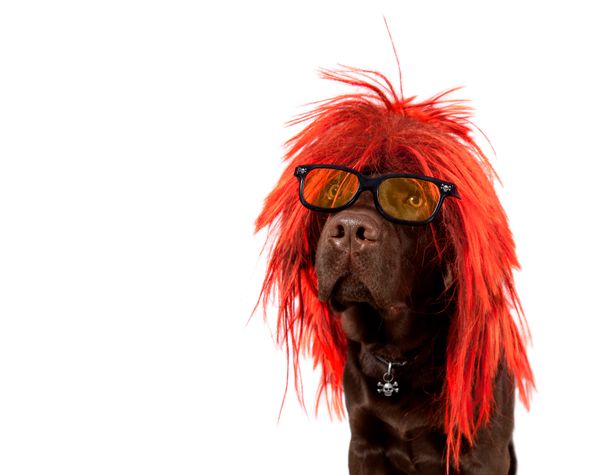
Fashion trends will come and go, but after seeing these animals wearing wigs, you'll agree that some styles are timeless.
Have a look at that confident pooch, sporting golden locks and a
lime green blouse. She's ready for a day at the groomer. Or the horse
with such stunning braids. They sure do accentuate the long face.
Just beware of this cat in the pink wig. The neon color really highlights that piercing gaze. Check it out: