Fun Animals Wiki,Videos,Picture,Stories
Showing posts with label dog. Show all posts

Thursday, January 25, 2018

Meet the street animals that stole scientists’ hearts


Cats and dogs that wander on to field sites can become cherished companions — but their presence isn’t always welcome.
Archaeologist Louise Hitchcock went to Israel in 2017 to look for artefacts from the Iron Age. She also found something else — a large dog who wormed his way into her heart.

The mongrel was skinny and skittish when he appeared at the dig site where Hitchcock, who studies Greek prehistory at the University of Melbourne in Australia, was working. A previous owner had apparently dumped him, and no local family wanted him. “I liked him, and I just couldn’t let him be abandoned again,” Hitchcock says. Apprehensively, she shipped him home.

Today, the 35-kilogram saluki mix, who is named Fred, enjoys a life of walks and belly rubs. Although he was fearful and occasionally aggressive in Israel, he has since become mellow and friendly, Hitchcock says. “He will now go up to strangers and want to have his neck scratched.”

Like Hitchcock, many researchers spend substantial time in the field, where they might confront large numbers of apparently homeless cats and dogs. For some scientists, animals that wander up to a research site provide welcome companionship. But they can also pose a direct threat to scientific projects (see ‘Hounded and harassed’).

PDF version
Stray cat

Peeping tom: a street cat looks on as an archaeologist examines a stone wall in Thasos, Greece. Credit: Chelsea Gardner

Archaeologist Louise Hitchcock went to Israel in 2017 to look for artefacts from the Iron Age. She also found something else — a large dog who wormed his way into her heart.

The mongrel was skinny and skittish when he appeared at the dig site where Hitchcock, who studies Greek prehistory at the University of Melbourne in Australia, was working. A previous owner had apparently dumped him, and no local family wanted him. “I liked him, and I just couldn’t let him be abandoned again,” Hitchcock says. Apprehensively, she shipped him home.

Today, the 35-kilogram saluki mix, who is named Fred, enjoys a life of walks and belly rubs. Although he was fearful and occasionally aggressive in Israel, he has since become mellow and friendly, Hitchcock says. “He will now go up to strangers and want to have his neck scratched.”

Like Hitchcock, many researchers spend substantial time in the field, where they might confront large numbers of apparently homeless cats and dogs. For some scientists, animals that wander up to a research site provide welcome companionship. But they can also pose a direct threat to scientific projects (see ‘Hounded and harassed’).
Hounded and harassed

Free-roaming cats and dogs imperil some native species, complicating the work of scientists who study those creatures. Published studies say that dogs have contributed to the extinction of 11 vertebrate species (T. S. Doherty et al. Biol. Conserv. 210, 56–59; 2017) and cats to the extinction of at least 63 (S. R. Loss and P. P. Marra Front. Ecol. Environ. 15, 502–509; 2017). Dogs and cats not only eat native species; they can also transmit fatal diseases.

When Abi Vanak began studying the interactions of wild carnivores at a nature reserve in India, he set up camera traps to monitor the local jackals, foxes and jungle cats. Instead, dogs were the most frequently photographed carnivore, says Vanak, a conservation scientist at the Ashoka Trust for Research in Ecology and the Environment in Bangalore, India.

Vanak and his colleagues presented authorities with a plan to reduce dogs’ impact, but met with little success. If he could do it again, he would present his team’s ideas to village councils, which would help to win community support, he says.

Bonaventura Majolo, a primatologist at the University of Lincoln, UK, knew of two dog attacks on wild Barbary macaques, Macaca sylvanus, while he was studying the endangered species in Ifrane National Park, Morocco. In each case, the monkey that was bitten soon disappeared — an almost certain sign that it had died.

Conservation biologist Joel Berger acted swiftly when he and his colleagues saw dogs chase a mother and baby takin, Budorcas taxicolor, a threatened goat-like herbivore. After the baby became stranded in the middle of a river at Jigme Dorji National Park in Bhutan, the researchers warmed it and gave it fluids.

But they did not see it again, nor did they see two additional calves that had become separated from their mothers by dogs that year. “We assume that their fates are not positive,” says Berger, of Colorado State University in Fort Collins and the Wildlife Conservation Society in New York City.

In many countries, cultural attitudes rule out the killing of invasive predators to protect wildlife, Berger notes. He urges researchers whose study animals are at risk to work with local conservation groups and government officials. He also recommends that scientists publish studies about the impact of dogs and cats to help motivate governments to act.

Wild rovers

Free-roaming ‘street dogs’ number perhaps 300 million globally, says Andrew Rowan, chief scientific officer at the Humane Society of the United States, based in Washington DC. Studies of ‘street cat’ numbers are limited, but Rowan’s self-described “crude estimate” of the worldwide cat total is 700 million; this includes cats that live in a community setting and those claimed by humans.

Inevitably, some of these street animals are hurt or sick, prompting some scientists to intervene or even to adopt one. Yet helping a suffering creature while in the field is not always easy. Time is often limited, and a step that would be simple at home, such as taking an injured animal to a vet, can be daunting in a region where such services are scarce.

But social media — which provides easy access to information and resources — and a growing global network of voluntary groups have eased the path for scientists who are troubled by the plight of needy animals.

The lives of free-roaming animals — and local attitudes towards them — vary enormously. In parts of the Caribbean, street dogs are well nourished and treated affectionately, says ecologist Ryan Boyko, who heads the canine DNA-testing company Embark Veterinary in Austin, Texas, and has sampled DNA from street dogs in nearly 40 countries. But in other places, such as parts of Africa, street dogs are emaciated, riddled with open sores and covered with parasites.

The dog that ultimately found a home with Hitchcock was, by comparison, in good health. Although thin and tick-ridden, he was neither injured nor sick. His sudden appearance at the dig site, in a remote national park, led Hitchcock to suspect that someone had left him to fend for himself.

Whenever possible, scientists who want to help such animals should first try contacting local groups, says Meredith Ayan, executive director at the Society for the Prevention of Cruelty to Animals International in New York City. Facebook is a good resource for finding local rescue groups. Community members are likely to know which animals that seem to be strays are actually associated with a household and don’t require feeding or care. Animal organizations with an international presence and vets might also be able to help.

Many animal-welfare groups advise caution for scientists in the field when it comes to feeding animals. Indiscriminate handouts, say group representatives, might create friction with local people and disrupt animals’ routines. “Once you leave, these animals don’t have food again,” says Joy Lee, who until the end of 2017 was based in Ahmedabad, India, where she worked for Humane Society International, an animal-protection organization that is active around the world.

Pet predicaments

That fate was exactly what Hitchcock feared for Fred and a second dog that appeared with him. “People were turning them into pets,” she says. “I thought, ‘In three weeks we’re going to leave and they’re just going to be discarded again.’ ” It seemed unlikely that Fred and his canine companion Fi belonged to the closest village, which was five to ten kilometres away.

Besides, Fred was timid, whereas the local sheepdogs were so aggressive that, for her own safety, Hitchcock feared to approach the shepherds to make enquiries. Worried about Fred and Fi’s future, she and others began working to find them homes.

An archaeologist friend helped Hitchcock to contact a local professor of veterinary medicine, who gave the dogs inoculations and tick medication. An Israeli scientist working at the site used the messaging app WhatsApp to find an adoptive family. But Fred’s family decided to give him up, and his only remaining option was a job as a prison guard dog. “That didn’t sound very good to me,” Hitchcock says. “I just had to rescue him.”

Researchers who, like Hitchcock, are troubled by the plight of such animals might want to support local vaccination drives. And many animal-welfare advocates recommend campaigns to sterilize free-roaming animals and return them to the community. But such trap-neuter-return, or TNR, programmes are controversial: modelling suggests that they can curtail populations in suitable areas, yet sustained success requires intense and long-lasting efforts, and few TNR programmes are rigorously monitored (P. S. Miller et al. PLoS ONE 9, e113553; 2014).

Meanwhile, the number of community organizations devoted to animal support is rising. In many parts of the world, the chance of finding a local partner is much higher than it was even five years ago, says conservation biologist John Boone at the Great Basin Bird Observatory in Reno, Nevada, who has studied the population dynamics of street cats.

And scientists who want to do more than donate money to support inoculation and other solutions can help in other ways. On two trips home to Toronto, Canada, from a field site in Greece, archaeologist Chelsea Gardner’s checked luggage included five large kennels, each holding a dog bound for an adoptive or foster family. Non-profit groups, such as Canada’s Paws Across the Water, arranged the placements, often through social media.


The groups also paid the animals’ airfares, which can cost Can$700 (US$550). It was up to Gardner, a faculty member at Mount Allison University in Sackville, to navigate customs with two or three baggage carts stacked with dogs. “We’re definitely a spectacle,” says Gardner. “People say, ‘Are they all yours?’”

A researcher who spends an extended period at one site can help by providing a foster home. Archaeologist Maria Liston of the University of Waterloo in Canada, who does field work in Greece, donates money to Nine Lives Greece, a local group. She also fosters cats in her Athens apartment — so many last year that “I lost track, honestly,” she admits, before guessing that the number was between 15 and 20.

Can’t help falling in love

Then there are the scientists who, like Hitchcock, fall in love with an animal. Among them is Ovee Thorat, a PhD student in conservation science and sustainability studies at the Ashoka Trust for Research in Ecology and the Environment in Bangalore, India. When a scrawny kitten began loitering at Thorat’s field station in Gujarat, about 1,500 kilometres away, the scientist felt compelled to help. She fed the kitten, dewormed her and named her Billo, a Hindi word that translates roughly to ‘beautiful girl’. Billo returned the favour, staying close to Thorat during the weeks and months when no other researchers lived at the field station.

When Thorat finished her fieldwork, she could not take Billo with her to her shared city apartment. So she asked the field-station staff and research crew to take care of her pet. Billo became the darling of the field station, where she is fed and cosseted.

Moving a new pet to a distant country is trickier than passing it on to colleagues. A scientist shipping an animal from India, for example, should set aside US$2,000 at a minimum, Lee advises, though the costs will depend on the destination and airline. Securing permits in India is complicated; the alternative is an Indian pet-shipping company that can handle the red tape.

After deciding to adopt Fred, Hitchcock turned to Terminal4Pets, an Israeli pet-travel agency, to help arrange his journey. The paperwork was minimal, but the costs were not: they came to about Aus$7,000 (US$5,500), most of it for Fred’s flights, his six-month quarantine in an Israeli kennel and a 10-day quarantine in an Australian kennel.

In some places, taking home a furry companion is easier than it was once. A single ‘pet passport’ is accepted by every country in the European Union and applies to dogs, cats and ferrets travelling between member states. The United Kingdom no longer imposes a six-month quarantine on incoming cats and dogs that have EU passports. Dogs imported to the United States are exempt from the federal requirement for a rabies vaccination if departing a country without rabies.

Adopted animals from war-torn countries can experience something akin to post-traumatic stress disorder, Ayan says. “It takes a while for the stress to wear off,” she says, and in a few cases, animals cannot adapt to their new homes. Fred takes anti-anxiety medication, although Hitchcock hopes to end the regimen within a year.

Sometimes intervention leads to a happy outcome. Fred, for example, initially feared car rides, vet visits and lifts, and Hitchcock worried that he’d chew up the house and clash with her little terrier. Now, he is outgrowing his anxieties, he doesn’t chew or bark and he doesn’t attack Hitchcock’s other dog.

Another story that ended well began on Gardner’s excavation site in Greece, when she and a friend started caring for two starving, tick-covered puppies. The closest shelter was far away and overrun with dogs, so the researchers fed the puppies, gave them flea and tick medicine and acclimatized them to humans in the hope that someone would adopt them. Wary of getting attached, the scientists called them only Brown Dog and Black Dog.

When Gardner returned to the site in 2017, she saw Brown Dog again — in a yard, wearing a collar. “That’s exactly what we had hoped for,” she says. “Something came of putting in all that time and effort. It was really a nice, happy ending for at least one of those dogs.”
read more "Meet the street animals that stole scientists’ hearts"

Tuesday, May 16, 2017

10 Animals With Amazing Hearing


Humans may be king of the animal world when it comes to evolution, but we are flailing down the hearing ranks. Although our hearing isn't as sensitive as some of these guys below (ours is a limited 2 to 5 kiloherz) - the way our brain processes vibrations into sound that then does amazing things to our memory and processing banks, evoking emotions is nothing less than magical. But, how does it all work? For more information on how humans hear, check out www.hiddenhearing.co.uk. However, let's not take away the glory from these hearing heavyweights, here's the top 10 animals with amazing hearing:

1. The greater wax moth
The greater wax moth
This little guy has the hearing crown, with a hearing frequency of up to 300 kiloherz, it can hear 150 times more than us and can even hear 100 herz above a bat (but as the bat is its number one predator it's going to need to outwit it somehow). Dr. Hannah Moir, told The Daily Mail: "Many species of moth have evolved ultrasound-sensitive ears owing to the predation pressure of echo-locating bats - this system is one of the best known examples of an evolutionary 'arms-race' between predator and prey."

2. Elephants
Elephants
It's no surprise really, with ears that big, that the elephant is going to be in the top 10! Their hearing frequency is somewhere in between 16 herz to 12 kiloherz which is a huge range and they can hear at a frequency 20 times lower than us.

3. Bats
Bats
Bats come second only to the moth. They use a biological sonar system called echolocation to find their way around in the pitch black. Their frequency level is around 212 kiloherz.

4. Dolphins
Dolphins
Like bats, dolphins use echolocation, waiting for sound to bounce back, so it's like seeing with sound. Their frequency range is 75 herz to 150 kiloherz.

5. Cats
Cats
Cats have a good frequency range - at 45 herz to 64 kiloherz it's far better than ours, so there's no point trying to sneak up on your cat!

6. Dogs
Dogs
A dog's hearing is similar to a cat, they hear better at a higher pitch and can even differentiate between their owner's footsteps and strangers. People have reported that their dogs know they are coming home before they even get there!

7. Owl

Owl
An owl's frequency range is between 200 herz to 12 kiloherz, and with their excellent eyesight and a head that can nearly turn 360 degrees you really don't want to be its potential prey!

8. Rat

Rat
Our friendly rodent has a better hearing range than the cat, which is just as well for them. At 200 herz to 76 kiloherz they can hear an incy-wincy spider coming down the drain pipe.

9. Horse

Horse
Horses need to have a good hearing as well as they actually have many predators in the wild - they are a flight animal and rely heavily on their hearing, which is much better than their sight. Their frequency range is 55 herz to 33 kiloherz. They can move their ears in the direction of the sound.

10. Pigeons


Pigeons
Pigeons have an incredibly low hearing frequency, something like 0.5 herz! This helps them to hear sound over long distance and to detect storms and helps them to navigate over long distances. According to OneKind they are only one of four animals that can recognize themselves in a mirror which was worth a mention in itself!
read more "10 Animals With Amazing Hearing"

Tuesday, April 18, 2017

5 Animals With An Extraordinary Sense Of Smell


Albatross

Albatross
Find Schools of Fish
The albatross can smell fish from the air. Researchers have found that an albatross will alter its course toward prey located well out of visual range. The birds can monitor a miles-wide swath of ocean as they fly in a single direction.

Eastern American Mole

Eastern American Mole
Smell In Stereo
Scientists recently discovered that the Eastern American mole smells in stereo. Because they're blind and have little use for hearing, moles use stereoscopic smell to determine their location and the location of their prey.


Moths

Moths
Locate A Distant Mate
Moths don't have noses. Instead, they have antennae covered in scent receptors. While they don't detect every scent well, male silkworm moths can sense a single molecule of female sex hormone from at least a mile away.


Sharks

Sharks
Detect Specific Proteins
Sharks breathe with their gills, so their noses serve only to smell. They are particularly well tuned for hunting. Sharks can sense a prey's amino acids at concentrations as low as one part per billion.


Dogs

Dogs
Target a Single Scent
Dogs have a keen ability to discriminate among smells. An Auburn tracking dog can follow a single human trail, laid more than 24 hours before, across a campus crisscrossed by tens of thousands of students.

read more "5 Animals With An Extraordinary Sense Of Smell"

Saturday, February 18, 2017

Why your dog never forgets


Scientists have long wondered whether what underlies 'smart' behaviour in animals is cognitive processes – in other words, thinking, an expression of some kind of intelligence.

Researchers started by studying non-human primates and have since demonstrated remarkable cognitive abilities in other mammals, including dogs.
dog
They have shown that dogs have significant capacity to remember associations between commands, situations and behaviour.

Recent research even showed that dogs can actually remember specific events, just like humans and other primates can.

In the early 2000s, a series of studies began to show unequivocally that dogs have sophisticated abstract abilities.

For example, they can follow pointing gestures, something that was previously thought to be a uniquely human capacity. 

A later study showed that dogs could do this even though chimpanzees, often thought of as one of the smartest animals, can't.

Dogs have also been shown to have numerical abilities, another skill previously thought to exist only in humans.

A 2002 study investigated the ability of 11 pet dogs to count by performing simple calculations in front of them using treats.

The researcher would place a number of treats behind a screen one by one and then reveal how many there were in total.

But sometimes the experimenter would manipulate the outcome so that the total of treats revealed at the end wasn't the same number the dog had seen placed there. For example 1+1=3 instead of 1+1=2.

The dogs spent significantly longer looking at the outcome of the manipulated calculations, as if the answer was not what they had been expecting.

This suggested that not only did the dogs anticipate the results of the calculations, but also that they held representations of numbers in their memory.


read more "Why your dog never forgets"

Tuesday, January 31, 2017

Animals are much smarter than people realize, scientist says


What is the smartest species in the world? You might think it's humans by a long shot, but the reality is a lot more complicated.
Frans de Waal, a primatologist at Emory University, has a new book out called "Are We Smart Enough to Know How Smart Animals Are?" and in it he gives hundreds of examples of surprising intelligence from non-human species, including many instances where other animals appear to be smarter than we are.

Chimpanzees, for instance, can easily beat humans at recalling a set of numbers that was displayed for a fraction of a second.

Octopuses can learn to open pill bottles protected by childproof caps, which many humans can't figure out on their own.

Dogs and horses, among many species that spend time around humans, are able to recognize body language cues that are lost on us.

Many species can do stuff we can't even imagine: bats that map out space with echolocation; birds that figure out the complex mechanics of flight and landing; and ticks that identify passing mammals by the smell of butyric acid.

In fact, every species' operating system is finely tuned to do what it needs to do, which makes intelligence comparisons across species rather pointless.

"It seems highly unfair to ask if a squirrel can count to ten if counting is not really what a squirrel's life is about," de Waal writes. "The squirrel is very good at retrieving nuts, though, and some birds are absolute experts .... That we can't compete with squirrels and nutcrackers on this task — I even forget where I parked my car — is irrelevant, since our species does not need this kind of memory for survival the way forest animals braving a freezing winter do."
Take chimpanzees, which share 99% of their DNA with humans. De Waal describes a female chimp named Kuif who learned to feed an adopted baby chimp with a bottle and knew to withdraw the bottle when the baby needed to burp. Still more impressive was how Kuif, every time she was called into a separate area for feeding, would first take the time to visit the alpha male, the alpha female, and several friends, waking them up if they were sleeping, and giving them a farewell kiss.

Dandy, a young male chimp described by de Waal, was smart enough not to reveal finding some buried grapefruits while in the company of larger males. Hours later he ran back unaccompanied to eat them alone.

Grande, another chimp, would sit quietly when unable to reach a banana hung from the ceiling, until in moments of inspiration she would spring up and try a new technique for reaching the banana: connecting sticks to create a longer tool or stacking boxes to climb higher.

Chimps show almost human levels of cognitive complexity in these actions. And again there are areas where chimp thinking surpasses human thinking — among them short-term recall and perhaps some kinds of social awareness.
read more "Animals are much smarter than people realize, scientist says"

Sunday, April 10, 2016

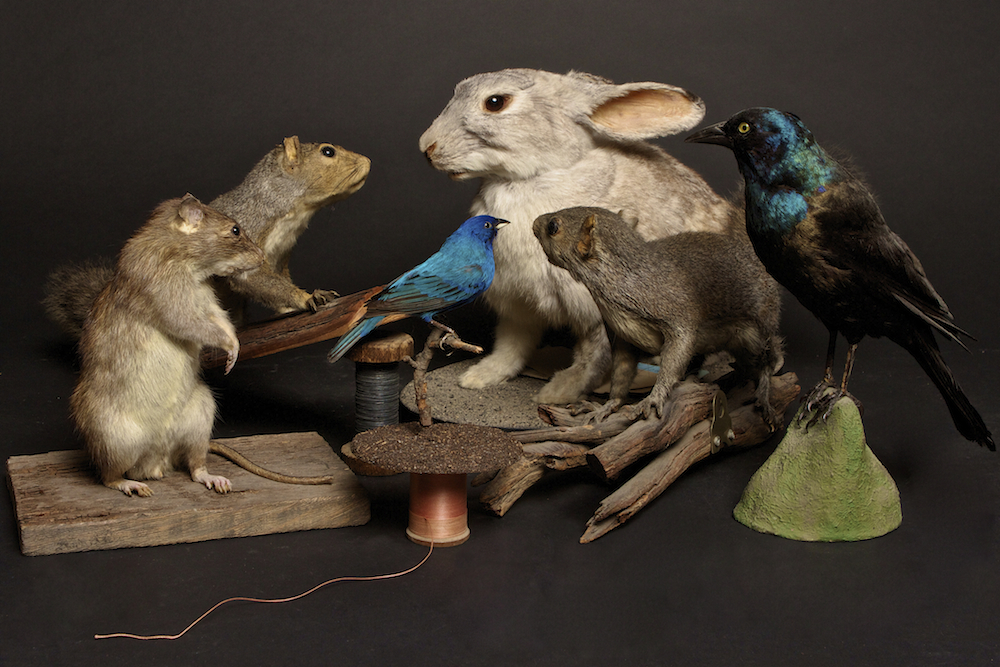
Taxidermied Animals Come Back to Life


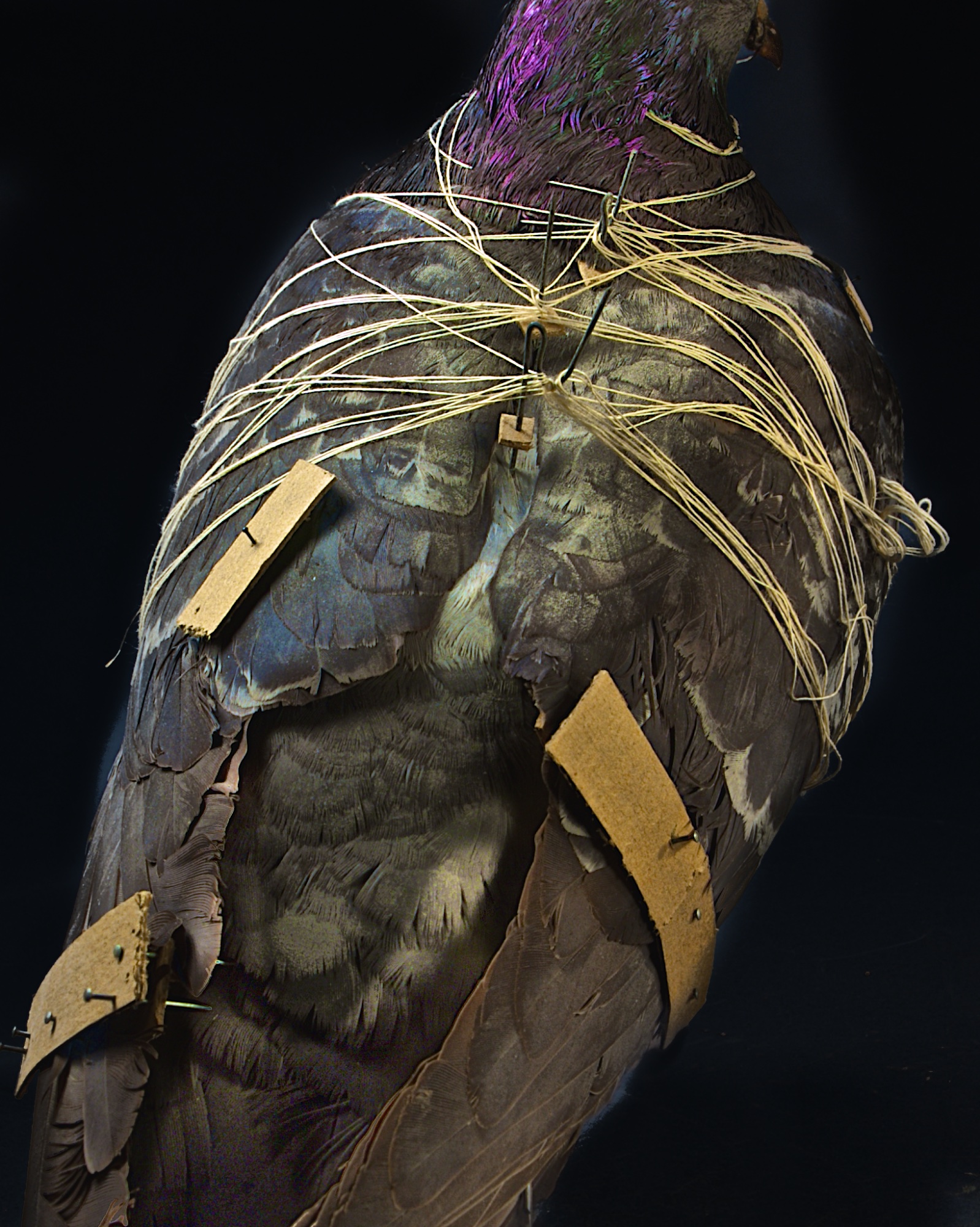
Taxidermy had not held much interest for Lynn Savarese, until she signed on as a volunteer photographer for New York City's American Museum of Natural History (AMNH). Though she was simultaneously working on numerous projects in travel, interior, and portrait photography, and as well as works featuring abstracted flowers in decay, her experience with the AMNH made her enamored of the world of dead animals.
“I grew mesmerized by this art form when photographing bird mounts for the AMNH’s archival digitization project,” Savarese tells The Creators Project. “Overwhelmed by the heartbreaking charm of these figures and their disquieting embodiment of both life and death, I sought to understand the medium better. I hadn’t known, for instance, that John James Audubon’s masterful rendering of birds depended on his proficiency as a taxidermist, or that Charles Darwin’s taxidermy skills were essential to his scientific pursuits.”
 
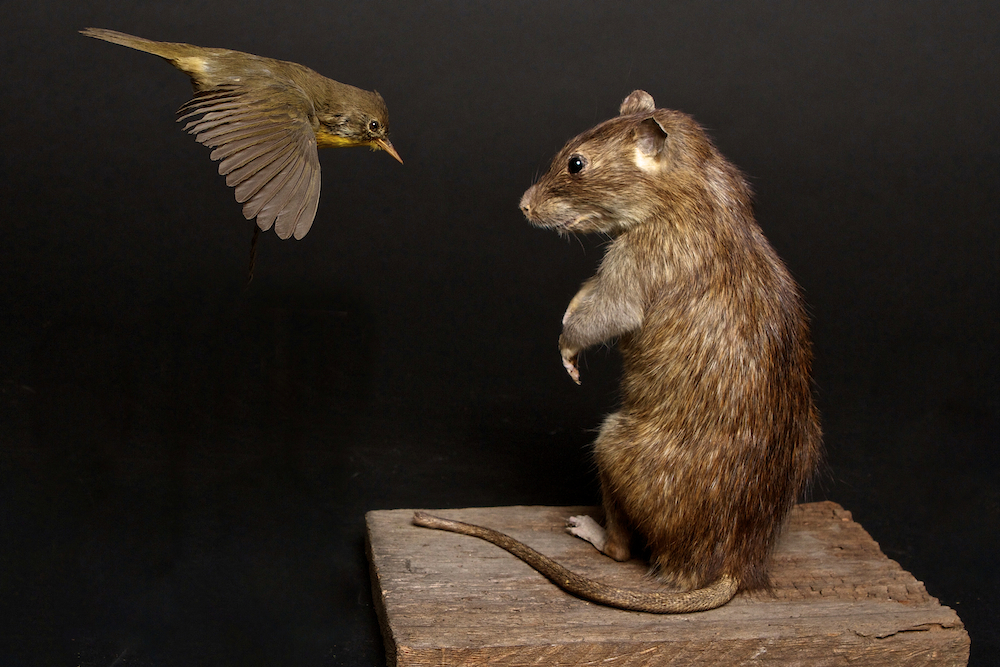
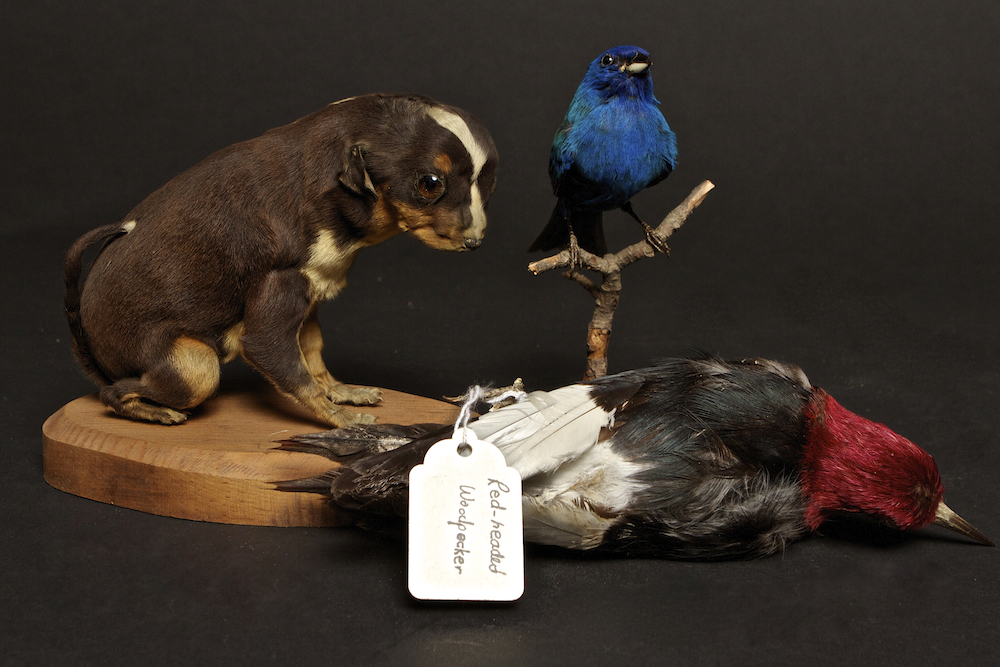
Rat and Bunting 14
During her time as a volunteer, Savarese began to see a narrative among the animals that displayed how life could be carried over into still form. “Through scientific knowledge and acute observation, precise sculptural artistry and theatrical intuition, the taxidermist aims to achieve the illusion of life through the remains of death.” Savarese explains. “Rarely are life and death portrayed simultaneously with such quiet force and wonder.”
 
Rat and Bunting 3
“While enthralled by the enigmatic beauty and character of these specimens, I never lose sight of man’s hubris in turning animals into replicas of themselves and the inherent irony in attempting to achieve immortality for them through killing them. Doubly ironic, however, is that I've never felt more deeply the wonder and beauty of our animal kin than in my close-up encounters with these mounted creatures.”
 
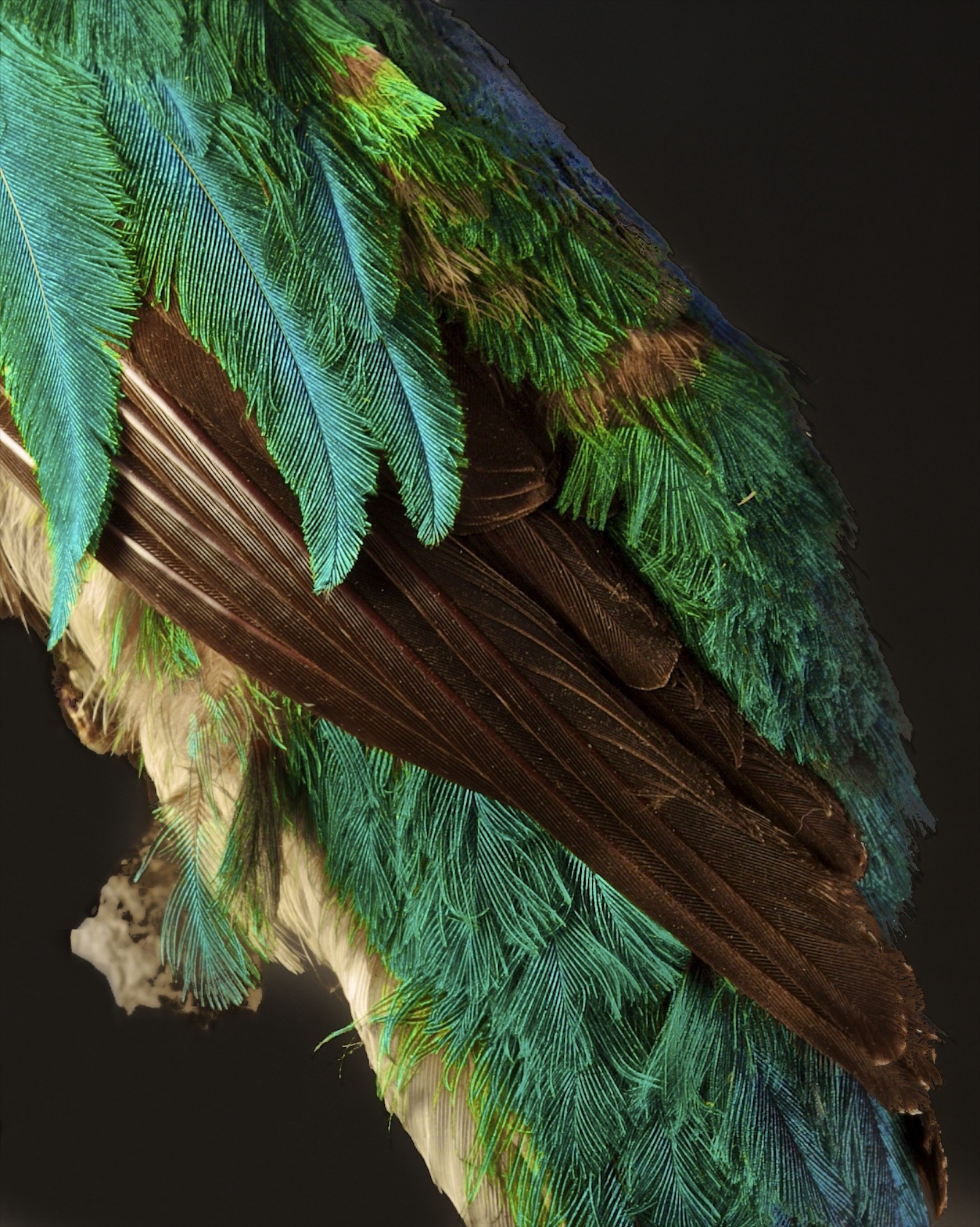
Plumis Zmaragdus
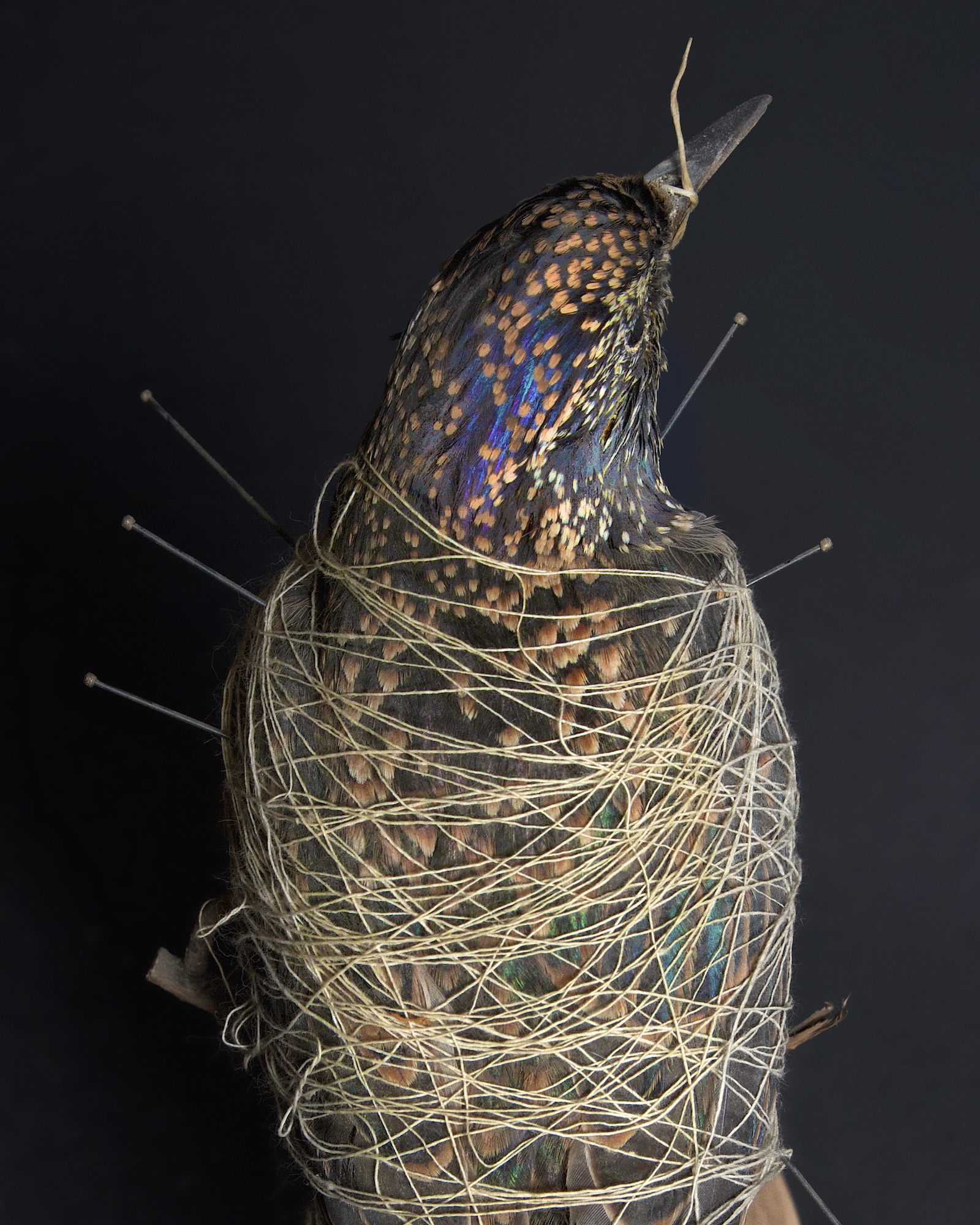
In her first taxidermy series, My Still Life Aviary, Savarese focused on the fate of mounted birds in limbo. “These specimens were too old and tattered to be put on public display, but federal and state law forbids the sale of any that are endangered species to any other party who might have an interest in preserving and protecting them," she tells us. In her second series, The Death and Life Adventures of Rat and Indigo Bunting, she was inspired by E.B. White's masterful portrayal of anthropomorphized animals. Recently, Savarese has started work on a more abstract series called Plumigeri, in which she examines the extraordinarily intricate patterns appearing on the feathered backs of mounted birds.
“In My Still Life Aviary series, my aim was to capture not only the haunting charisma of the mounted birds but also the ethical challenges they present, as well as their power to convey the endangerment and threat of extinction many bird species face today. Paying them tribute through photography became, for me, an almost reverential mission,” says Savarese. “In the future, I would like to experiment with different environments, and draw upon a greater variety of mounted animals.”
“I am excited to be revisiting mounted birds from a new perspective, and enjoying the much more abstract images that emerge when my focus is exclusively on their feathers.”
 
Prometheus Vinctus
 
Afigo
 
Rat and Bunting 9
read more "Taxidermied Animals Come Back to Life"

Wednesday, September 23, 2015

This is why you care more about some animals than you care about humans


Following the death of my childhood pet—a black cat named Neo—I had an extended mourning period that included a lot of open weeping and melodramatic Instagram posts.

We humans love animals. We house some of them in our homes, treating our pets like family. We stage funerals for those household pets—some places even offer cremation services specifically for animals, like this place in Whitman—and we also mourn the loss of creatures we never even saw in real life. We get indignant when animals are abused, talking about it passionately on social media. We react very strongly when animals are killed–sometimes even more strongly than we do when humans are killed.

How do we get so attached to animals?


A visitor pets a cat at the pop-up "Cat cafe", a cafe where patrons can interact and adopt cats, in New York, April 25, 2014. Cat Cafe, a pop up cafe which opened for only four days until April 27, 2014, allows visitors to have a coffee and interact with 21 cats and adopt one if they want. AFP PHOTO/Emmanuel Dunand (Photo credit should read EMMANUEL DUNAND/AFP/Getty Images)
Hal Herzog is a professor of psychology at Western Carolina University who analyzes humans’ interactions with animals. Speaking about household pets in particular, Herzog said said that people get attached to animals for a number of reasons, but that it’s mostly a combination of our biology and our need for affection.

As for the biology: “When you touch and look at your pet, it makes your brain release chemicals that make you feel good,” Herzog said.
President Barack Obama crouches to greet his dog, Bo, outside the Oval Office of the White House, in Washington, DC, 3-15-12.
As for the need for affection: That boils down to the fact that pets offer unconditional love (mostly). And unconditional love feels good.

This partly explains why so many people–about 60 percent of households, according to the Humane Society of the United States–currently own pets in the U.S. But making us feel better can’t be the only reason animals have climbed up the social ranks to be nearly equal with other humans, which is something that Herzog said is definitely not culturally universal.

Herzog said that while animals, especially dogs, are part of the lives of humans in many countries, they are not revered as family members in most other cultures. Americans have specifically come to idealize two animals–cats and dogs–more than any other.

Somewhere along the line, Westerners came to love certain animals so much that we allow them to sleep in our beds.

  Herzog pointed to the influence of pet-centric media and advertising. The pet industry markets pets as desirable companions, loving creatures that will make you feel less lonely and make your life more satisfying.

Herzog also noted the impact of animals’ portrayals in popular culture and how that might be related to our desire to own pets.

“When I was a kid, we got a TV, and my favorite show was Lassie,” Herzog said. “And Lassie was Teddy’s best friend. And they treated him like a member of the family.”
tumblr_ns8a21oEzr1s7fmt1o1_500
Marley & Me didn’t fail to deliver gut-punches that tapped into the way some of us feel about dogs. 
Moreover, changing demographics are motivating people to get more and more pets, Herzog said. As the structure of the average American household continues to change, spaces are created that are easily occupied by animals.

“American demographics have changed, and more people are living alone. People are getting married later, if they get married at all. They’re having fewer kids,” Herzog said. “People are more attached to their pets [because they’re filling a hole].”

That all accounts for why we like them so much. But do we really like them more than human beings?

Herzog doesn’t think so.

We only allow two types of animals to become family members: cats and dogs. Barring that, we don’t really develop deep, emotional bonds with animals (well, most of us don’t). Second in the hierarchy of critters-that-matter-to-people are what Herzog calls “charismatic megafauna,” or what he describes as “big, cool animals.” These are, he said, “giraffes, lions, orcas, dolphins, chimpanzees,” and the like.

Lions like Cecil, the 13-year-old Southwest African Lion whose death in July sparked worldwide outrage.
cecil
Herzog said that Cecil had the right combination of positive characteristics to cause public outrage about animal cruelty. Not only did he fall into the category of beasts that we, as Americans, care about, he also had a few other things going for him:

“Cecil wasn’t just any lion. He was really well-known,” Herzog said. “He was charismatic. There were pictures of him everywhere.”

Combine that with the fact that there was a clear, identifiable killer with a history of engaging animal cruelty, and Cecil’s death became the exact sort of thing we care about.

“It was the perfect storm of how to get the whole world in a tizzy,” Herzog said of the circumstances surrounding Cecil’s death.

According to Herzog, any animal that doesn’t belong to one of two categories–household pets or adorable zoo animals–doesn’t matter to us as much. Just looking at America’s propensity to eat certain critters on the regular proves that we seriously prioritize the lives of some animals over others.
“There’s a general principal in psychology called the collapse of compassion,” Herzog said. “This principle [says] that the bigger the tragedy, the less people care. So people don’t care that much about the slaughter of chickens and the treatment of cattle. What gets people going is pictures of the individual suffering of animals.”

Take, for instance, the death of a dog. It certainly doesn’t happen as frequently as the death of cows and chickens, and it doesn’t tend to happen en masse. The stories that spread like wildfire are ones about small, individual injustices, like when a dog was bound and shot in Key Largo, Florida, last year. Or, as Herzog pointed out (and wrote about in an op-ed for Wired magazine), a dog named Arfee from Idaho was shot by police officers in the summer of 2014.

Arfee’s death received more attention than the deaths of  42 million cows that are killed for human consumption each year. And it got even more media attention than the death of a pregnant Idaho woman who was shot by police officers on the exact same day. But still: Herzog is adamant that, overall, we don’t care about animals more than humans.

“I just don’t think it’s true that we care about animals than people. When you look at the big picture, it’s just not true,” Herzog said.

“What we care about is individuals,” Herzog said. “Especially ones that are helpless.”

This was best demonstrated by a study out of Northeastern University that tracked people’s reactions to fake news stories about beatings that happened to either dogs, puppies, human adults, or human babies. According to the study, which was conducted by professors Jack Levin, an expert in violent crimes and mass murderers, and Arnold Arluke, a professor of sociology who studies the psychological and emotional link between animals and humans, “adult human crime victims receive less empathy than do child, puppy, and full grown dog victims.”

So it’s not the difference between human and animal–it’s the innocence of the victim.

Yusuf the kitten waits for adoption at the 'Best Friends' rescue shelter group at the inaugural CatConLa event in Los Angeles, California on June 7, 2015. The two day cat expo for cat people claims to be the first of its kind in North America and showcases everything to do with felines. AFP PHOTO/MARK RALSTON (Photo credit should read MARK RALSTON/AFP/Getty Images)
“Humans can speak for themselves, as a group, while animals are helpless,” Herzog said. “People are [sometimes] more interested in helping animals because animals can’t help themselves.”

So there’s the reason you weep at the Sarah McLachlan commercials (the song doesn’t help), and why I cried for days after my cat died, and why we talk a lot about animals who were killed unfairly.

We don’t feel bad for them because they’re animals. We feel bad for them because, for the most part, they’re innocent.

read more "This is why you care more about some animals than you care about humans "

Sunday, July 26, 2015

Boxer Dog


Boxers are a bright, energetic and playful breed and tend to be very good with children. They are active dogs and require adequate exercise to prevent boredom-associated behaviors such as chewing or digging.
Boxer Dog
Boxers have earned a slight reputation of being headstrong, which can be related to inappropriate obedience training. Owing to their intelligence and working breed characteristics, training based on corrections often has limited usefulness.
Boxer Dog
Boxers, like other animals, respond much better to positive reinforcement techniques such as clicker training, which affords the dog an opportunity to think independently and to problem-solve.

Boxers were originally a docked and cropped breed, and this tradition is still maintained in some countries. However, due to pressure from veterinary associations, animal rights groups and the general public, both cropping of the ears and docking of the tail have been prohibited in many countries around the world.

read more "Boxer Dog"

Wednesday, February 18, 2015

6 of the First Domesticated Animals


Humans have long used animals to make their lives a little easier. Since the time of the hunter-gatherers, men taught animals to help them with work, as well as guard and protect them and their food. Below are the first few animals that we had domesticated over the past thousands of years.

Dogs
Dogs
Dogs have stayed by our side for more than 10,000 years. They stared out like wolves, wild and free, but humans started to befriend them and domesticated them. Archaeologist can set domesticated canines apart from wild wolves though certain features, like smaller teeth and "Sagittal crest". Different dig sites across the world confirmed that canine domestication is a worldwide phenomenon

Cows
Cows
There are a number of wild cattle that were domesticated in different places and times. thetaurine, which is the most common early domesticated cattle, is said to have been domesticated around 8,000 years ago in the Fertile Crescent. They are also the most common domesticated cattle used in trading. The zebu, which originated in the area around Pakistan, was domesticated 7,000 years ago. While the capeletti, which was common in the African and Egyptian areas, were used by humans as early as 9,000 years ago.

Goats and Sheep
 Goats and Sheep
We can’t forget the other common heard animals. Humans are said to have herded goats and sheep in about the same time as they domesticated dogs. Goats and sheep are mainly used as livestock, for food, milk, fur and their skin. Sheep are more common in colder areas since people needed their wool to create fabrics. 

Horses
 Horses
The strongest animal that humans have ever domesticated, horses are used in agriculture, trade, constructions of empires, and even to war. These huge beasts have definitely made our lives much easier, especially when it comes to listing heavy load. There are still a few wild horses in certain parts of the world. However some wild horses are actually feral horses like the mustangs in the United States and the brumby in Australia.

Cats
Cats
Cats became our companions at around 7000 years ago when we started to grow our own food instead of gathering or hunting. As humans stored and collected grain, cats became very useful to help keep mice away. The ancient Egyptians are said to be the first people who domesticated these animals, not just to help them keep the mice away, but for religious and cultural purposes as well. they worshiped a cat-goddess and treated their cats will the highest respect. They even mummified them when they passed away.

Snails
Snails
This might sound shocking, but snails are actually one of the first animals we domesticated. Our ancestors kept them mainly for food since snails are packed with nutrients and they’re easy to take care of. Many Paleolithic digs have also found large numbers of snail shells, taking their domestication back to earlier than 12,000 years ago. Since they’re very close to containing all the nutrients we need, they’re also very famous with traders, pilgrims and even those who went in campaigns.
read more "6 of the First Domesticated Animals"

Thursday, February 5, 2015

The Siberian Husky


Despite its name, the siberian husky is mainly bred in North America and the United States, originally a working dog.


The husky has a thick fur coat which enables the dog to be adequately warm in sub-zero temperatures. This means the husky is often used in the mountains of Alaska and Canada mainly for pulling sleds.
read more "The Siberian Husky"

Monday, January 26, 2015

Dogue De Bordeaux


The Dogue has an even temperament, and is extremely loyal and devoted to his master and family. Dogue de Bordeaux is gifted for guarding, which he assumes with vigilance and great courage but without aggressiveness.
Dogue De Bordeaux

He is a very good companion, being attached to and affectionate toward his master and family. He is calm and balanced with a high stimulus threshold.
read more "Dogue De Bordeaux"

Friday, December 19, 2014

Brazilian Terrier


The Brazilian Terrier, commonly called Fox Paulistinha, is a breed of dog developed in Brazil. It is one of several terriers probably descended from the combining of the Fox Terrier with other small breeds.
Brazilian Terrier
The appearance of the Brazilian Terrier is typical of dogs descended from fox terrier types. The short coat is tri-colour. The skull is flat and wedge-shaped, with folded ears. The tail may be docked or natural.
Brazilian Terrier
Brazilian Terriers are alert, intelligent and playful with stronger than average hunting instincts. They should not be left alone with small animals. They must be kept active and occupied, becoming destructive or restless if bored.
read more "Brazilian Terrier"

Thursday, November 27, 2014

Yorkshire Terrier

Although a toy breed, the Yorkie still retains much of its terrier ancestry in terms of personality. Individual dogs will differ, but they are generally intelligent, independent and courageous. Yorkshire Terriers are quick to determine where they fit in a household's pack. Their behavior towards outsiders will vary, they often will be inclined to bark at strangers, but some Yorkies are outgoing and friendly towards new people while others are withdrawn and aloof.
Yorkshire Terrier
The differences in behavior in this regard are largely based on how the owner trains or conditions (and socializes) the Yorkie. A few individual Yorkshire Terriers may be timid or nervous, rather than bold, but the vast majority do seem to meet the breed standard for a confident, vigorous and self-important personality.
Yorkshire Terrier
The Yorkshire Terrier seems oblivious of its small size. It is ever eager for adventure. This little dog is highly energetic, brave, loyal, and clever, with above average intelligence. Affectionate with its master, it can become suspicious of strangers and aggressive to strange dogs and small animals, if not properly socialized.
read more "Yorkshire Terrier"

Sunday, November 16, 2014

Afghan Hound


Afghan Hound History and Domestication
The Afghan Hound is thought to be one of the oldest of all domestic Dog breeds, with the first records of the Afghan Hound dating back to 4,000 BC. The fast and agile nature of this Dog meant that they made excellent hunters of small game in their native Afghanistan, most commonly hunting Deer, Goats, Gazelle and Wild Boar along with seeing off larger predators such as Wolves and Snow Leopards. Their gentle nature also made this elegant sight-hound a doting shepherd, fearlessly protecting livestock from hungry predators. This beautiful but gently natured watchdog was brought to Britain in the early 1920s and it's entry to the USA followed in 1926. The elegance of the Afghan Hound meant that they quickly became highly desirable Dogs, both as pets and for show.
Afghan Hound
Afghan Hound Physical Characteristics
The most characteristic feature of this breed is the long, silky fur that covers the Afghan Hound's body, most notably on the top of it's head. Afghan Hounds are most commonly black or golden in colour although a number of colour variations now exist within the breed including brown, grey and white. The elongated head and muzzle of the Afghan Hound make them easily identifiable, along with their high hip-bones which gave the ancestors of the modern day Afghan Hound their reputation for speed and agility. The face of the Afghan Hound is usually a black-coloured mask, with a black nose and dark almond shaped eyes. The colour of the facial mask is known to vary although white is said to be discouraged as it is seen as a sign of poor breeding. They are fairly large Dogs standing on average at 68cm in height.
Afghan Hound
Afghan Hound Behaviour and Temperament
The temperament of the typical Afghan Hound tends to be aloof and dignified, but happy and intelligent and generally relatively playful. However, the Afghan Hound has a reputation among Dog trainers for having a relatively slow obedience intelligence possibly due to their slightly stubborn nature. The Afghan Hound has a leaning towards independence and owners should not be surprised if their Dog sometimes chooses to ignore commands. The modern day Afghan Hound is said to have many Cat-like tendencies, loving to laze around the house and is generally much slower than it's Middle Eastern ancestors. The Afghan Hound is seldom used for hunting in Europe and America today where they are one of the most popular domestic Dog breeds.
Afghan Hound
Afghan Hound Breeding
The Afghan Hound was first bred in the ancient deserts of Egypt and Afghanistan, where they were primarily used as hunters. The Afghan Hound was a favoured choice of Dog as they were able to outrun the majority of other animals, whilst being courageous hunters and were capable of thinking independently, often able to keep larger prey from escaping until the hunter arrived. The first domestic breeding of the modern day Afghan Hound was by an English officer station near Kabul, who later brought the Afghan Hound to the UK in 1925. A year later, the Afghan Hound was taken to America where it's beauty and elegance made it one of the most prestigious breeds of domestic Dog in the States.The average litter size of the Afghan Hound is around 7 puppies, which are blind when first born.
Afghan Hound
Afghan Hound Interesting Facts and Features
When the Afghan Hound breed was first brought to America, it's naturally independent nature led to it gaining a reputation for being untrustworthy. Today however, many of these traits are not quite as prominent in the breed as they once were. The high hip-bones of this Dog are thought to be one of the main reasons why the Afghan Hound once had a reputation for speed, making them faster at running than most other domestic Dog breeds today. The long topknot on the top of it's head, along with the small ring near the end of it's tail, are two of the most distinctive features of the mature Afghan Hound. They originate from the mountains of Afghanistan and their unique appearance provides these Dogs with vital advantages during the cold winters and hot summers. Although beautiful, this long fur takes daily care and maintenance to ensure that the coat remains healthy.

read more "Afghan Hound"